

Liability for
AI-generated
Pictures.
Liability for
AI-generated
Pictures.
of
Artificial intelligence can create images that look deceptively similar to other people’s works within seconds. But who bears the legal responsibility if copyrights are infringed – the software, its manufacturer or the user who gave the command?
A competitor, an AI and a foreign photo
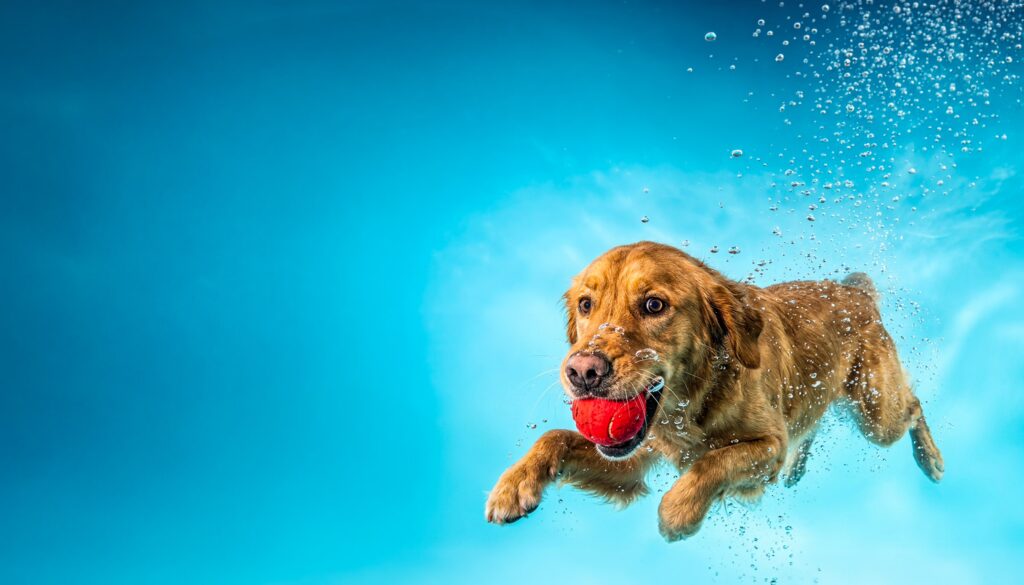
A pet photographer who offers professional underwater photography of dogs has created and post-processed an image showing a dog under the surface of the water snapping at a red toy. The photo captivates with its realistic dynamics, which were achieved through conscious decisions regarding framing, perspective, exposure and focus.
A former cooperation partner of the photographer, the operator of a dog school on the Lower Rhine, uploaded this photo to AI software. He prompted the software to generate a new image from it and published the result on his website. The AI image shows the same motif: a dog under water with a red toy. However, the style is comic-like and visually differs considerably from the original photo. It was not known which prompts the operator had used.
After an unsuccessful cease and desist letter for copyright infringement, the photographer applied for a preliminary injunction.
Do AI-generated images infringe copyrights?
With Decision of 02.04.2026 – Ref. I-20 W 2/26 the Düsseldorf Higher Regional Court dismissed the application for a temporary injunction, but stated the fundamental responsibility for AI-generated images and possible copyright infringements.
Is the AI image a “free edit”?
The OLG first examined whether the AI product should be classified as a so-called free adaptation within the meaning of German copyright law. A free adaptation is so far removed from the original work that it is considered an independent work and does not require the consent of the author of the original.
The decisive factor here is that the result of the processing itself is a copyright-protected work, i.e. a personal intellectual creation. In the case of AI-generated products, this is at best the case if human creative decisions shape the creation process in such a way that the personality of the user is reflected in the result.
This was completely lacking here. The former cooperation partner had not explained which specific creative decisions he had made when prompting, even after a judicial reference in the oral hearing. Therefore, the AI image could not be an independent work and the question of free adaptation did not even arise.
Does the AI image infringe the photographer’s copyright?
However, the court denied a direct infringement of the photographer’s copyright. For this to be the case, the creative elements of the original photo based on a personal creative decision would have to have been incorporated into the AI image.
In a photograph, these are typically decisions such as framing, perspective, lighting and the sharpness or blur achieved through aperture and exposure time. In the photographer’s original photo, practically only the dog’s head and the toy were visible, as the dog’s body almost completely disappeared due to the chosen perspective and blurring. This combination of focus and dynamics was the creative achievement.
The AI image, on the other hand, showed the entire dog’s body in a comic-like style, without the photographic dynamics of the original. Only the motif was adopted, i.e. a dog reaching for a red toy under water. However, the motif itself is not the result of a personal, creative decision by the photographer and therefore does not enjoy copyright protection. Copyright protection exists for specific works, not for ideas or motifs.
Does the AI image also infringe the photographer’s ancillary copyright?
The ancillary copyright contained in the copyright protects photographers even if their photo does not reach the creativity threshold of a photographic work. However, this law also requires that the specific photographic work is used. As the AI image did not adopt any of the photographer’s photographic design decisions, there was also no infringement of this property right.
According to the concept of work defined above, the decisive factor is therefore ultimately whether the defendant’s prompting expresses his creative abilities in an independent manner by making free and creative decisions and thus also giving the output his personal touch.
In the run-up to the hearing, the Higher Regional Court drew the parties’ attention to a ruling by the European Court of Justice from December 4, 2025. In it, the ECJ clarifies the concept of a work as an autonomous concept of EU law. Accordingly, an object can only be considered an original and thus enjoy protection as a work if it reflects the personality of its author and expresses their free creative decisions. If, on the other hand, the design was determined by technical processes or other constraints that do not allow artistic freedom, it lacks the necessary originality.
For AI-generated content, this means that not every technically complex prompting leads to a copyrighted product. The decisive factor is whether the human intervenes in the process in such a concrete and individual way that their personality is reflected in the result. A mere selection from several AI suggestions is just as insufficient as general, open-ended instructions to the software.
Significance for practice
Anyone who creates AI images runs the risk of infringing third-party copyrights. If third-party photos are uploaded, the uploading of a protected work to AI software can in itself constitute a copyright infringement, regardless of what the generated image looks like. This aspect was not the subject of dispute in this case.
Copyright protection for an AI-generated result presupposes that the human being makes specific, individual creative decisions during prompting and that these are demonstrably reflected in the output. Anyone claiming that an AI product is a work bears the burden of presentation and proof. However, this is likely to be difficult to achieve in reality.
Conclusion
Anyone who creates a photo using artificial intelligence cannot generally invoke their own copyrights. If they wish to do so, they must make a comprehensive claim.
However, even if a third party uploads their own photos to an AI in order to generate a new image, this only constitutes copyright infringement if the features that make a photo a copyright work are adopted by the AI. There is no motif protection.
However, even uploading an image to an AI is likely to constitute a copyright infringement.
In practice, this ruling raises a number of follow-up questions that are likely to continue to occupy the courts in the coming years. At what level of prompt control does a copyright-protected work possibly arise? How can a user provide concrete proof of this? And how can photographers and other creative professionals effectively defend themselves against such practices?
We are happy to
advise you about
AI!