

Copyrights
to symbols in
construction plans.
Copyrights
to symbols in
construction plans.
of
Can technical symbols in construction plans simply be copied? What level of creativity does copyright law require for standardized representations? What does the ruling mean for planning offices and their symbol libraries?
Introduction
Anyone who builds up their own symbol library over the years often regards it as a valuable trade secret. However, whether such technical symbols for cabinets, beds or lights are also protected by copyright is another matter. The Cologne Regional Court has drawn a clear line in an extensive legal dispute in the field of medical and supply technology planning. The decision is of interest to all planning offices, architects and technical planners who work with CAD libraries.
The dispute over the symbol library
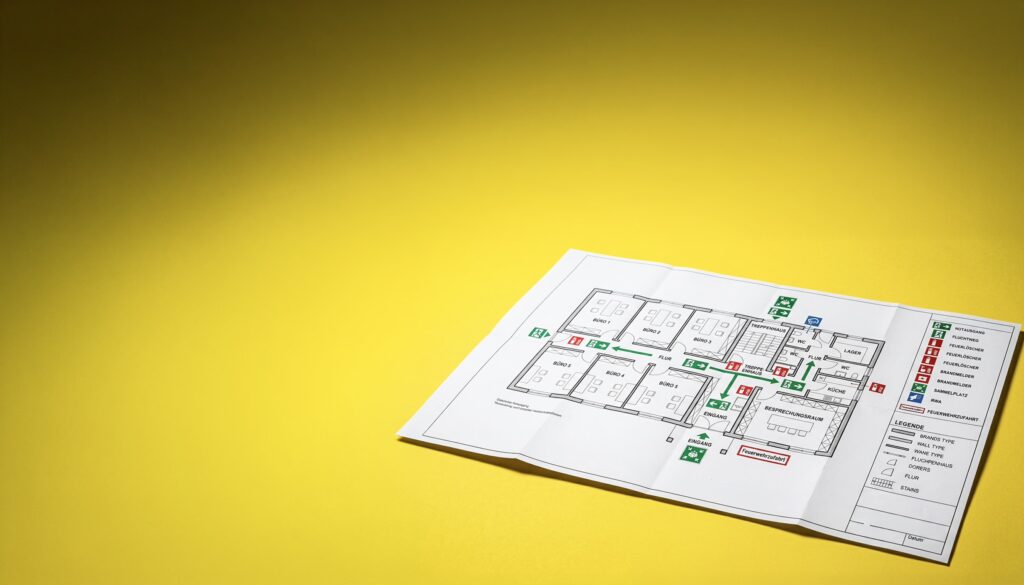
A company in the field of medical and supply engineering demanded an injunction, information and compensation from a competitor’s office and a fire protection expert. The background was the use of small, schematic symbols in construction plans for the reconstruction of a hospital department. Specifically, it concerned around two dozen symbols that were used in a floor plan and in a fire protection concept to represent everyday hospital objects such as patient beds, cupboards, equipment rails and lights.
The planning company claimed that its employees had developed this symbol library over many years in numerous meetings. Each individual symbol had been deliberately alienated and designed to be product-neutral. Two of the defendants had previously worked as draughtswomen at the planning company or its predecessor company and were said to have worked on the library there. From the point of view of the plaintiff, the subsequent use of similar symbols by the competing companies was a copyright infringement.
The defendant offices argued that the symbols were customary in the industry and largely predetermined by standards such as DIN 199. There was already a lack of creative leeway. In addition, the signs had merely been transferred to a CAD database without any personal creation having taken place.
The decision
The Cologne Regional Court dismissed the action with Judgment of 05.03.2026 – Ref. 14 O 195/24 completely rejected. For the majority of the symbols, the required level of creativity was already lacking. The same standard should be applied to representations of a scientific or technical nature as to works of applied art. It is necessary that the design reflects the personality of the author and expresses a free creative decision.
In the case of standardized symbols for everyday objects in clinics, one cannot cross the threshold of an artistic achievement. The scope is severely limited by technical requirements and the need for legibility. In addition, there is a considerable need for freedom of use, as such forms are required by other planners for comparable representations. The fact that other competitors use other symbols is not in itself sufficient to conclude that there is creative leeway. The Chamber expressly prohibited a presumption of creative choice.
The court only considered copyright protection to be conceivable in principle for two lamp depictions. At this point, however, the lawsuit failed due to a lack of legitimacy. The plaintiff had only made a general reference to a team of at least four draughtsmen without explaining who had made which specific design decision. A purely abstract description is not sufficient if the other side denies that the named persons created the work jointly.
A purely abstract description of design decisions and the naming of persons who may have made these decisions is not sufficient in the opinion of the Chamber.
The action could not be based on the supplementary protection of performance under competition law either. The symbols were subordinate elements of complex construction planning. Clients such as clinics or awarding authorities are not guided by individual symbols, but by the planning service as a whole. The Chamber therefore rejected the competitive character of individual symbols. As a result, all subsequent claims for information, destruction, recall, determination of liability for damages and reimbursement of warning costs also failed.
What the decision means in practice
If you want to rely on the copyright protection of your own CAD symbol library, you have to overcome high hurdles. The decisive factor is proof of free, creative design. The more a drawing is determined by standards, legibility or manufacturer neutrality, the more likely it is that copyright protection will be ruled out. This applies in particular to simple pictograms, which are essentially only intended to depict one thing in a recognizable way.
The decision also shows how important it is to carefully document authorship. Companies that want to defend their library against imitators later on should record as early as possible which person created which sign in which version. A blanket reference to a team that existed years ago is not sufficient in the event of a dispute – especially if the other party disputes this claim and objects that only existing drawings were digitized.
Anyone wishing to actually protect graphic works worthy of protection as a whole should also check whether the library can be classified as a database work or as a database in the sense of sui generis protection. The court pointed out that this object of protection had not been asserted in the proceedings. Without a specific submission, such a direction of protection will not be taken up.
On the defense side, the decision shows that accusations of copyright infringement of individual symbols do not have to be accepted across the board. If a planning office receives a cease and desist letter for the use of industry-standard symbols, it should have a legal examination carried out at an early stage to determine whether the level of creativity has been reached at all and whether the opponent can specifically demonstrate authorship. It is often precisely this point that leads to the failure of claims.
Conclusion
Copyright protection for technical symbols is possible, but the requirements for this are very high. Standardized symbols in construction plans are generally not covered. Companies that set up their own libraries should therefore take a broader view of their protection concept and not rely solely on copyright law. At the same time, the decision calls for proper documentation of authorship in the event of a later dispute.
We are happy to
advise you about
Copyright!