

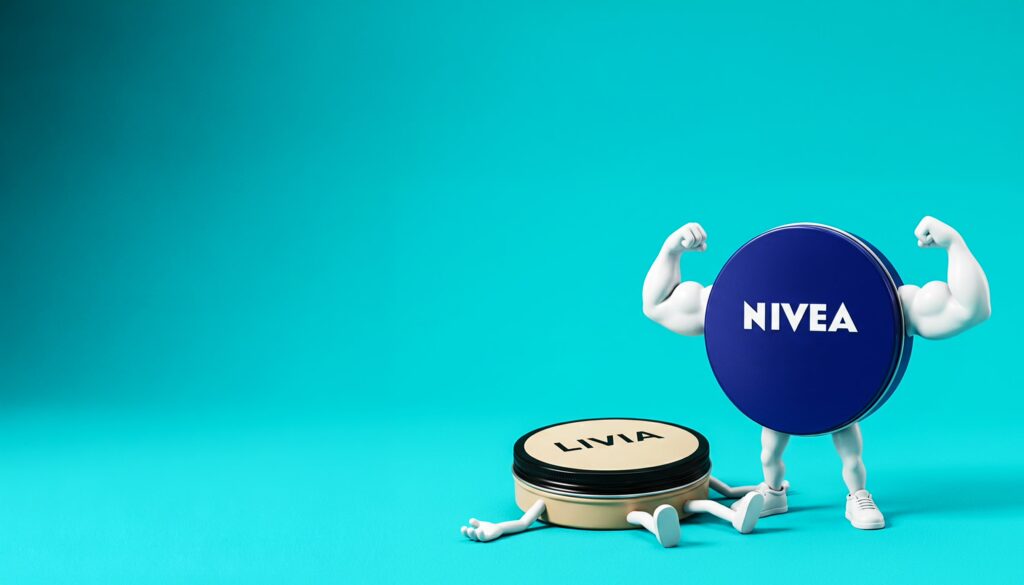
NIVEA
vs.
LIVIA.
NIVEA
vs.
LIVIA.
from
Can a brand name fail because it sounds similar to a well-known trademark? Yes – this is shown by a recent decision of the EUIPO in opposition proceedings.
What was the case about?
The US cosmetics company Livia Beauty Inc. had applied to the EUIPO to register the word mark “LIVIA” for cosmetics in Class 3. Beiersdorf opposed the application, relying, among other things, on its long-registered EU word mark “Nivea”. The Opposition Division of the EUIPO issued Beiersdorf on 04.05.2026 – Ref. B 3 233 870 law and rejected the application in its entirety.
Why does LIVIA sound like NIVEA?
The decisive factor for the decision was the English pronunciation of both names. The EUIPO found that “NIVEA” and “LIVIA” sound almost identical in English. Both have three syllables, end in “-via” and “-vea” respectively and have a similar speech rhythm and vowel structure. The only difference is the first letter. N versus L.
It is particularly noteworthy that the Office stated that the letters N and L are also closely related acoustically. They are both formed at the same place in the mouth, namely at the small arch directly behind the upper front teeth. According to the Office’s assessment, however, this slight difference at the beginning of the word is not sufficient to rule out confusion.
The words sound very similar and differ only slightly in the sound of their initial consonants “N” and “L”, which are also phonetically very similar, as they are both alveolar consonants formed at the same place of articulation.
The Office focused its analysis on English-speaking consumers, as this group has the strongest phonetic similarity. For German or French-speaking consumers, the perception could be different. However, since a likelihood of confusion in only one part of the EU is sufficient to refuse an application, this assessment was sufficient.
Conclusion
With this decision, the EUIPO has confirmed that the phonetic similarity of two trademarks is sufficient to prevent an application – even if the signs are visually different. It did not even depend on the reputation of the NIVEA trademark.
Companies should take this into account in their trademark strategy when applying for new trademarks. In the case of EU trademarks, the different pronunciations in all official EU languages may also matter, as similarity in a single language may be a sufficient obstacle.
We are happy to
advise you about
Trademark law!