

Super Bowl
and event names as
trademark.
Super Bowl
and event names as
trademark.
of
Can a company secure the name of a world-famous sporting event for cookies and chocolate? And what do consumers think when they see “Super Bowl” on a package of candy? The Federal Patent Court has rejected the application. Event names continue to face challenges when used as trademarks for promotional products.
Cookies for the Football Championship Game
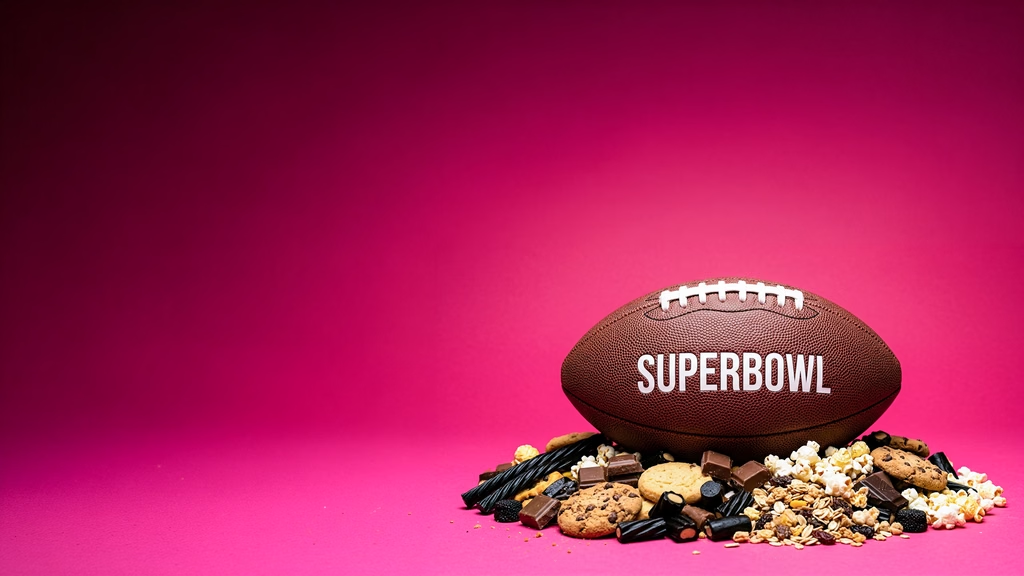
On February 4, 2022, a company filed an application with the German Patent and Trademark Office (DPMA) for the word mark “Super Bowl.” It sought protection for a long list of baked goods and confectionery products. These include cookies, chocolate, licorice, ice cream, popcorn, muesli, and peanut butter. “Confectionery items used as Christmas tree decorations” were also included in the list.
The DPMA rejected the application on March 13, 2023. “Super Bowl” refers to the championship game of the U.S. professional football league, the NFL. For several years now, retailers have been specifically offering products for this event. The mark therefore merely indicates that the goods are intended for consumption in connection with the game. It must remain available to competitors and is not distinctive—that is, it is not suitable for associating goods with a specific company.
A bowl instead of a sporting event?
The applicant, however, argued that consumers would not think of a game broadcast in Germany in the wee hours of the night. Rather, they are familiar with “Bowl” from the food trend, such as a breakfast bowl or poke bowl. The term therefore refers to the English word for “bowl.” The mark gains distinctiveness through the unusual addition of “Super,” which is not found in common references to “bowls.”
During the appeal proceedings, the company did not submit any statement of grounds. Following a written notice from the court, it withdrew its request for an oral hearing and asked for a decision to be rendered in writing.
Federal Patent Court Dismisses Appeal
In its decision dated August 19, 2026—Case No. 25 W (pat) 543/23— the Federal Patent Court dismissed the appeal. The application thus remains rejected for all claimed goods. The court based its decision solely on the lack of distinctiveness. It expressly left open the question of whether the designation must be kept available for competitors.
Why aren’t event names suitable as trademarks for promotional merchandise?
In the court’s view, the German public is familiar with the Super Bowl. It is one of the world’s largest single-sport events and is also advertised domestically. Retailers in this country use the game as an occasion for promotional campaigns. The court cites, for example, a Penny flyer from 2020 featuring “Snacks for the Super Bowl” and “Super Bowl Weeks” at an EDEKA store in January 2022.
Baked goods and sweets were perfect for this occasion. They required no preparation and could be eaten while watching TV or at a public viewing event. In the flyers, brownies, cookies, muffins, and biscuits were explicitly advertised as accompaniments to the game. The name of the event merely signaled a special occasion for eating them. The public was accustomed to this usage.
What does sponsorship have to do with this?
The crux of the decision lies in the question of how consumers interpret an event name on a product. The court believes that consumers do not see it as a reference to a specific manufacturer. Rather, they assume that someone is using the name with permission, such as a paying partner of the event.
Rather, it will assume that the applicant—possibly as a sponsor, in return for her financial contributions—has been granted permission to use the event trademark in question.
The prerequisite is that the event be generally known in connection with the goods for which the trademark was registered. The court considered this to be proven based on the retailers’ advertising. In doing so, it follows the case law of the Federal Court of Justice regarding the designation “FUSSBALL WM 2006.”
For manufacturers, this presents a double hurdle. In the eyes of the public, the event name describes the reason for the purchase. And to the extent that it refers to a company at all, the court held that it refers to authorization from a third party, not to the manufacturer.
Does the second meaning save the trademark application?
The court did not accept the argument regarding the “bowl” trend. It acknowledged that “Super Bowl” could be understood, for example, as a dish served in a bowl—such as cereal. However, the majority of the public also—or exclusively—sees it as the sporting event.
For a mark to be rejected, it is sufficient that one of its multiple meanings lack distinctiveness. Anyone who does not perceive a mark as an indication of origin in one sense will not perceive it as such in any other sense either. A harmless secondary meaning therefore does not help if the obvious interpretation fails.
The court even found a connection to Christmas tree ornaments made of sugar. There is extensive merchandising surrounding the NFL, including tree ornaments in the shape of helmets and footballs. It is conceivable that such ornaments could be made of sugar rather than glass.
Conclusion
The court explicitly cites the 2006 FIFA World Cup, and the application concerned the core category of typical promotional merchandise. The message is clear for manufacturers. Anyone who wants to market a major event must rely on their own distinctive trademark. In terms of trademark law, this remains an individual decision by a panel of judges, not a new precedent.
However, the issue of sponsorship raises a question that the court does not address. If consumers assume that the organizer has given permission, they will see a connection to a specific company—namely, the organizer. This argues against registration by a third party. The ruling leaves open whether the same reasoning would also preclude registration by the organizer itself.
We’d be happy to
advise you on
Trademark law!