

Amazon screenshot
does not prove any
publication.
Amazon screenshot
does not prove any
publication.
of
Does a current Amazon screenshot, which notes that a product has been on sale since 2015, show what that product looked like at that time? And is a design owner only allowed to present new evidence in response during the appeal process?
A tool holder and a screenshot from the year 2024
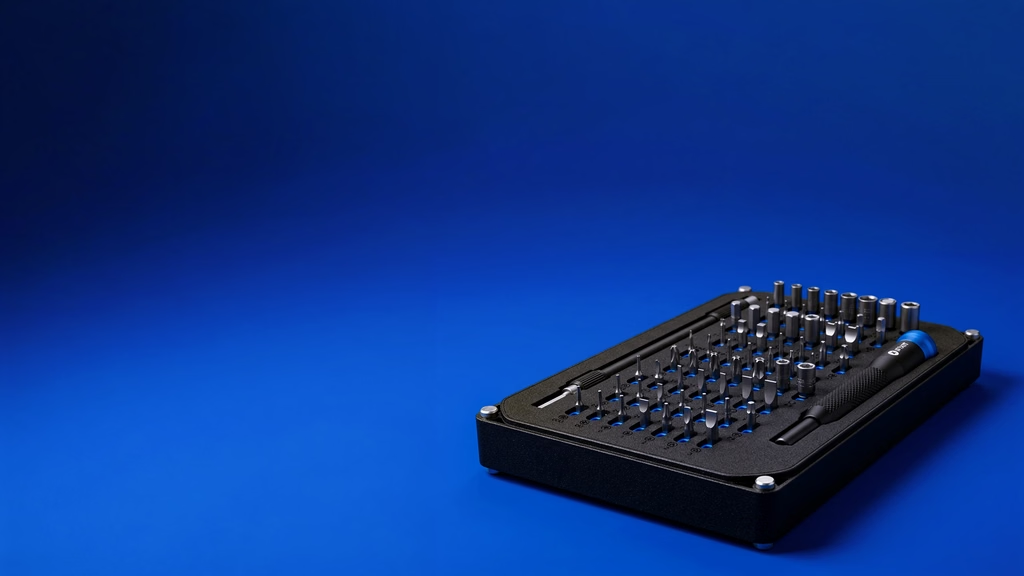
iFixit GmbH, which we represent, is the owner of a registered EU design. The design, filed on November 21, 2016, depicts a flat, black tool holder and is registered for tool bags and tool holders.
On August 2, 2024, two companies filed a request with the EUIPO to declare the design invalid. They argued that it was neither new nor distinctive. Distinctiveness means that a design creates a different overall impression than earlier designs. As evidence, the applicants submitted screenshots of an Amazon listing for a tool set from iFixit. The listing indicated that the product had been available since November 21, 2015—exactly one year before the design was filed.
The EUIPO’s Invalidity Division granted the request on September 4, 2025, and declared the design invalid due to a lack of distinctiveness. The screenshot indicated that the product had been offered in the form shown since at least November 21, 2015. The Division considered the objection that the offering might have changed since then to be a mere assertion. We filed an appeal against this decision.
What we presented to the design owner
In our complaint, we argued that the screenshot from 2024 shows only the features that were available at that time. The listing date is tied to the ASIN, the Amazon Standard Identification Number. It indicates when that number was created, but not which images were visible at that time. iFixit GmbH and its parent company, iFixit in the U.S., have changed the product specifications and photos over the years, always under the same ASIN.
We submitted three documents as evidence. An archived version of the same offer dated June 21, 2020, showed different photos than the screenshot from 2024. A test report dated August 27, 2017, and a product video dated November 23, 2015, also showed a different version of the product. Alternatively, we invoked the grace period for novelty. This protects a design from disclosures made by the designer or their legal successor within the twelve months prior to the filing of the application.
The applicants countered that a modified product could not be offered under the same ASIN. Furthermore, they argued that the design protected only the tool holder and not the tools housed within it. However, they contended that the tool holder had remained unchanged. They also argued that the new documents were submitted late and should therefore not be considered.
Appeals Board Rejects Request for Nullification
In its decision dated August 26, 2026—Case No. R 1718/2025-3— the EUIPO Board of Appeal overturned the decision of the Invalidity Division and dismissed the request for invalidation. The design therefore remains registered.
What does an Amazon screenshot prove?
In the Chamber’s view, the disclosure of an earlier design cannot be substantiated by probabilities or assumptions. Concrete and objective circumstances are required. The Invalidity Division wrongly relied on a judgment of the General Court (judgment of February 27, 2018—Case No. T-166/15). In that case, the applicant had submitted not only archived Amazon pages but also an invoice, emails, and statements from third parties. The judgment specifically does not state that an Amazon printout is always sufficient, regardless of the circumstances.
Regarding the ASIN, the Chamber referred to its own earlier findings. The ASIN is assigned when the product information is first created. It therefore indicates only the earliest possible date of publication, not the actual date. The seller is free to choose the listing date and can change it at any time; technically, it can even be backdated.
It follows from these findings alone that the screenshot from 2024 submitted by the petitioners does not reliably indicate when a product was first listed under the ASIN […] or what form that product took.
Added to this was the counterevidence. The archived page from 2020 showed different images under the same ASIN than the screenshot from 2024. The argument that every product change requires a new ASIN is therefore unfounded.
Is it sufficient if the owner has remained the same?
The applicants had argued that the differences concerned only the tools and not the protected holder. The Chamber did not accept this argument. The video and test report showed a different product than the screenshot from 2024, as evidenced, for example, by the blue end cap on the bit driver. This established that the screenshot did not show the product as it had allegedly been disclosed previously.
A party seeking a declaration of invalidity must prove the existence of an earlier design whose overall impression, taken as a whole, is comparable to that of the contested design. Proof that individual design features were already known is not sufficient. The Board bases its decision on a ruling by the ECJ (ECJ ruling of June 19, 2014 – Case No. C-345/13). According to that ruling, a design must be compared with individual prior designs and not with a mosaic of features from various prior designs.
The Board disregarded a screenshot of an article dated November 25, 2015, that was submitted only after the fact. The application for invalidation defines the subject matter of the dispute; additional, earlier designs cannot be introduced at a later stage.
Can new evidence be submitted only in the appeal?
The proceedings took place during the transitional phase of the EU design law reform. The Board assessed whether the design was eligible for protection under the old law because it was filed in 2016. For the proceedings themselves, however, it applied the new regulations in effect as of July 1, 2026.
Accordingly, the EUIPO may, but is not required to, reject late evidence. The Board emphasized its broad discretion. Late evidence should be taken into account, for example, if it appears at first glance to be relevant to the decision. The same applies if it supplements earlier evidence or challenges findings made in the first instance. Both of these applied to our documents.
The petitioners had argued that the owner must explain why she had not submitted the documents earlier. In the Chamber’s view, no such obligation can be inferred from either the regulations or case law. An affidavit that had already been submitted in the first instance was received within the deadline.
How does this align with previous case law?
To date, the General Court of the European Union has attributed significant probative value to Amazon listings. In a dispute over a chair design (General Court judgment of March 15, 2023 – Case No. T-89/22), it upheld the view that the mere abstract possibility of manipulation does not invalidate a screenshot. Listing data on Amazon is far less easily alterable than, for example, entries on Wikipedia.
The new decision does not openly contradict this line of reasoning. According to the Chamber, the court had already required, as early as 2018, serious and substantiated evidence of a change. Such evidence was provided in this case by the archived version and the video. What is new is the clarity with which the Chamber distinguishes between the ASIN date and the product design. We have already reported on the requirements for social media evidence in our article on screenshots as proof of disclosure.
Conclusion
The decision strengthens the position of design owners against invalidity actions based solely on current platform printouts. However, it also shows how much depends on the evidence to the contrary. It remains unclear how the Board would have ruled if the owner had merely alleged changes to the offering but had been unable to substantiate them.
Another unresolved issue is the grace period for novelty within a corporate group. The Chamber did not have to decide whether a publication by the parent company benefits the subsidiary as the design owner. This has practical significance for corporate groups with distributed rights to the design.
We’d be happy to
advise you on
Design rights!