

Stiftung Warentest
wins against
chip.de
Stiftung Warentest
wins against
chip.de
by
Anyone who presents Stiftung Warentest’s top-rated products and includes purchase links alongside them is profiting from the work and reputation of others. The Frankfurt am Main Regional Court has prohibited a major consumer portal from doing exactly that. The reasoning behind this ruling is also relevant for retailers and manufacturers who use test results to promote sales.
Top-Rated Product with Purchase Link
Stiftung Warentest tests products and publishes the results in its magazines and on test.de. The detailed test reports, including overall and individual ratings, are available there behind a paywall. A single test report costs 4.90 euros; alternatively, a flat-rate subscription is available. Anyone wishing to advertise using the test logo can purchase a license for it through RAL gGmbH.
The defendant operates the technology and consumer portal chip.de. According to the court’s findings, the site had a monthly average of over 20 million users in 2024. More than 25 percent of advertising revenue depends on transactions, such as commissions from affiliate links. An affiliate link is a link to an online store for which the person who posted the link receives a commission when a purchase is made.
The lawsuit concerned three articles.
- Washing Machines.
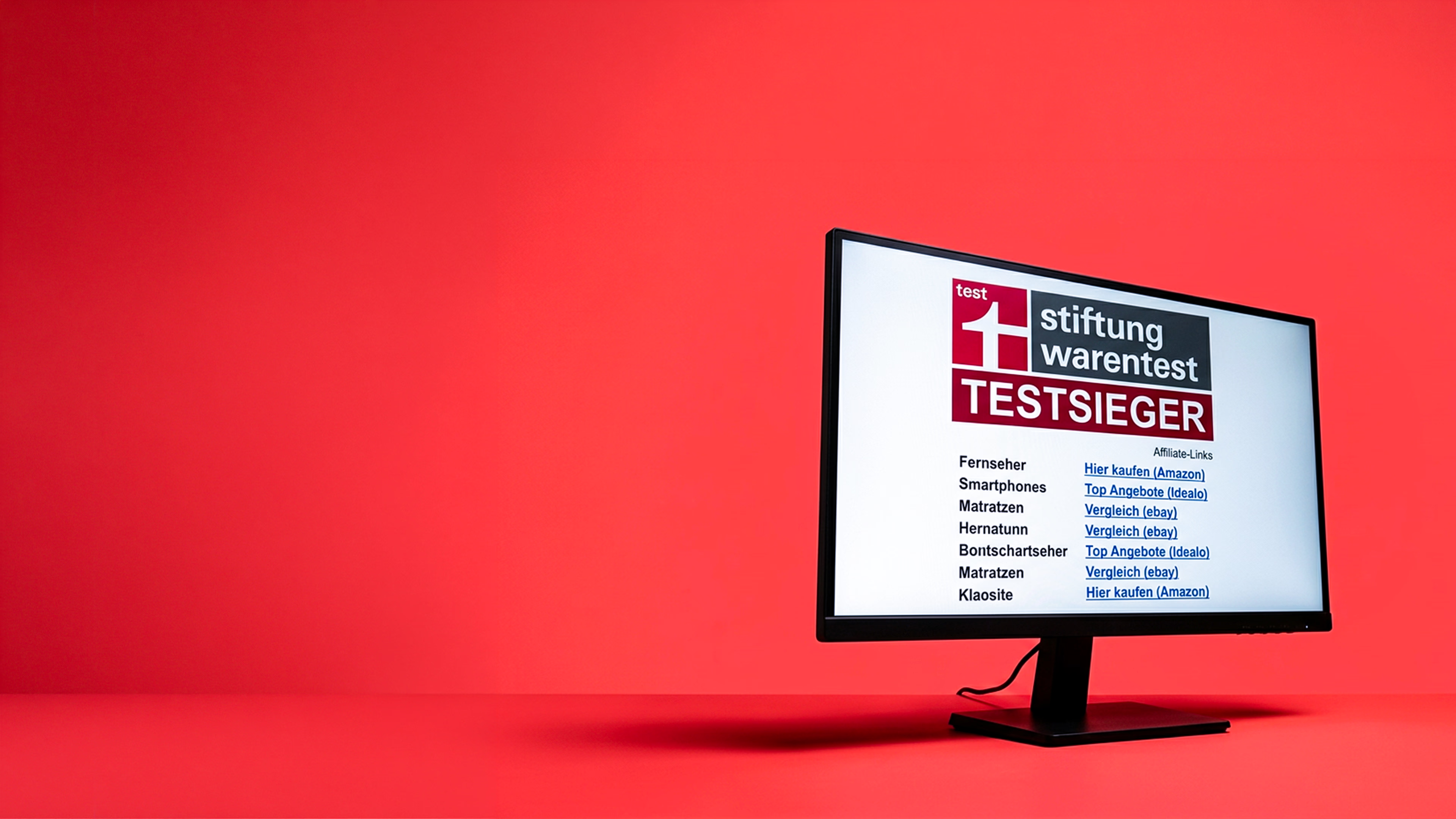
On February 2, 2025, an article was published about the 2024 test winners from Stiftung Warentest. It contained over 40 links to product listings, test ratings, price comparisons, and the foundation’s logo. - Water-saving showerheads.
On June 28, 2025, chip.de presented four of the 20 showerheads tested in a table. In addition to the overall ratings, individual ratings—which the foundation charges a fee for—were displayed, along with 12 affiliate links. Two product images featured unlicensed test logos. - Dog food.
On July 8, 2025, an article about dog ice cream was published, which listed the four top-rated products from a 2022 test along with all individual ratings, also including affiliate links.
Why the Dispute Arose
The parties had discussed a collaboration in 2019 without reaching an agreement. At the end of 2024, the foundation sent a draft agreement to journalists, including those at the defendant’s publication. According to the draft, no more than three specific product reviews were to be mentioned, and no affiliate links were to be included. The agreement was not signed.
On June 4, 2025, the foundation issued a cease and desist letter. A settlement proposal from the defendant called for affiliate links to be placed only in separate boxes rather than within the body text. Stiftung Warentest rejected the proposal. The defendant cited its editorial activities, an implied permission dating back to 2019, and estoppel. Furthermore, it argued that test results do not constitute a protected database.
The Frankfurt Regional Court ruled in favor of Stiftung Warentest
In its judgment of September 17, 2026—Case No. 2-03 O 313/25 —the Frankfurt am Main Regional Court granted the complaint in its entirety. The defendant may no longer advertise using the Stiftung Warentest mark and logo in the form that was the subject of the complaint. It may not reproduce test results in the form at issue without consent.
When Does a Review Become Advertising?
Press reports enjoy special protection. According to case law, an editorial article is not considered a commercial act as long as its sole purpose is to inform readers. The situation is different if the article appears excessively promotional. Legal experts refer to this as “excessive promotion.”
In this regard, the court relies on the case law of the Federal Court of Justice regarding influencers (judgment of September 9, 2021 – Case No. I ZR 90/20). According to this case law, even a single link that directly enables the purchase of a product generally constitutes an excessive promotional element. In the case of chip.de, the chamber found that this threshold had been clearly exceeded. One to two affiliate links per product dominated the appearance of the posts. This gave readers the impression that the primary focus was on commissions. Third-party ads on the left and right reinforced this impression. The fact that a website must be financed through advertising does not change this.
Why is this a trademark infringement?
“Stiftung Warentest” is registered as a word trademark and as a word/figurative trademark. The court considers the trademark to be so well-known that it has determined it to be common knowledge. Therefore, it did not need to evaluate a survey submitted by the foundation, which indicated that 93 percent of the population is familiar with the foundation.
Well-known trademarks are also protected against third parties exploiting their good reputation for their own business purposes without providing anything in return. The Trademark Act refers to this as the unfair exploitation of reputation. In the Chamber’s view, chip.de exploited the public’s trust in the foundation to attract readers and redirect them to sales offers. Furthermore, the free publication of test results that are otherwise subject to a fee made purchasing the tests from the foundation unattractive.
This is because the minimal—if any—editorial content of these posts is offset by an excessive use of affiliate links, through which the defendant appropriates the plaintiff’s third-party services for its own corporate benefit without just cause.
The court rejects the claim of implied consent. The 2019 discussion did not, in fact, result in any agreement. Forfeiture is also ruled out. By the time the draft agreement was prepared in late 2024, at the latest, the defendant could no longer have relied on the foundation’s tacit consent to this use. The fact that the foundation remained largely inactive between 2019 and 2024 is irrelevant.
Are test scores a protected database?
In addition to trademark law, the court based its ruling on the database creator’s law under the Copyright Act. This law does not protect a creative work, but rather the investment in the collection, verification, and processing of data.
The Chamber treats each individual product test as a separate database. The results from the testing institutes would have to be evaluated, processed, and maintained, which would require a significant amount of effort. The court accepted the Foundation’s statement on this matter as true without conducting a formal hearing of evidence.
It is prohibited to reproduce a substantial portion of the database, whether in terms of type or scope. In this case, the court deemed the quality of the content sufficient. Test winners, overall ratings, and individual scores constitute the core of any database. Anyone who distributes precisely this information for free deprives the foundation of the revenue it uses to finance its tests.
What does this mean for retailers and manufacturers?
The ruling directly affects a media company. For retailers and manufacturers, however, the consequences are tangible, as their product pages and advertising materials are intended to drive sales anyway. Therefore, they generally cannot invoke the protection afforded to editorial reporting.
- Logo available by license only.
According to Stiftung Warentest, anyone wishing to advertise using its logo must obtain a logo license agreement, which is handled by RAL gGmbH. During the proceedings, the foundation also objected to the use of unlicensed test logos on product images. - Test tables are risky.
According to the court’s reasoning, the use of individual ratings and rankings from multiple products may constitute an infringement of database law. The court did not rule on whether this also applies to individual overall ratings in a single online store. We consider this question to be open. - Keeping an Eye on Partner Content.
Many manufacturers and retailers operate affiliate programs with comparison websites. Whether the advertiser is also liable for its partners’ content was not at issue in the proceedings. From a business perspective, however, a ban on a partner could impact the advertiser’s own sales channel.
Regardless of trademark law, advertising that includes test results is subject to the requirements of competition law, such as ensuring that the source is clearly legible.
Conclusion
The outcome comes as little surprise. Anyone who promotes third-party “test winners” with numerous purchase links is engaged in sales rather than reporting. The link between trademark law and database protection nevertheless makes the ruling noteworthy for rights holders.
We take a critical view of the reasoning regarding the database. The court treats each individual test as a separate database and determines the investment without taking evidence. It remains to be seen whether an appellate court will follow this reasoning. A case we discussed involving the sharing of passwords for databases shows that the “substantial portion” threshold is not always met. It also remains unclear at what point a contribution crosses the line. The ruling does not specify a fixed number of permissible links, and it did not have to rule on the proposal to place links only in separate boxes.
For retailers and manufacturers, this means one thing above all else: Advertising with Stiftung Warentest is done through a license, not by copying test tables.
We are happy to
advise you about
Focus!