


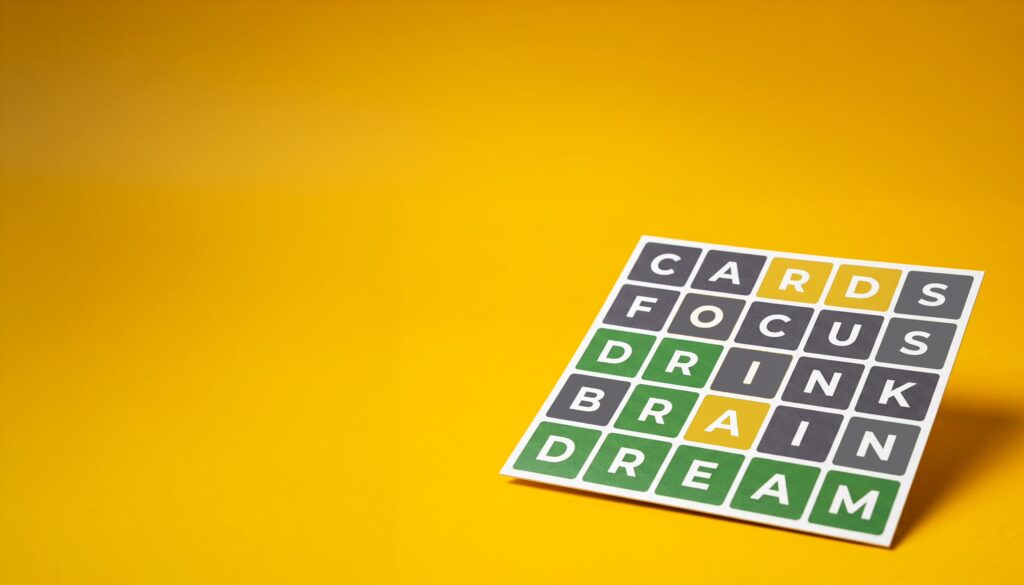
Wordle
without
Title of work.
Wordle
without
Title of work.
from
A hobby project becomes a global phenomenon overnight, a German puzzle publisher registers the name as a trademark, and The New York Times comes away empty-handed. When does copyright protection for a work actually take effect? And what does this ruling mean for everyone who publishes something online without thinking about it as a business?
What was the case about?
In June 2021, British developer Josh Wardle published a simple word puzzle on his personal website: Every day, there was a new five-letter target word, and players were given six attempts and colored clues. The game was called “Wordle” and went viral starting in January 2022. By that time, over 100,000 people were visiting the site daily, including in Germany. The New York Times recognized the potential, negotiated with Wardle, and on January 31, 2022, purchased all rights to the game, including the name, from him.
Just one day later, on February 1, 2022, a German puzzle publisher—which publishes crossword puzzle books and puzzle magazines, among other things—filed an application for the word mark “Wordle” with the German Patent and Trademark Office. The publisher had already learned about the game in December 2021 and had programmed its own German-language version. The New York Times viewed this as an infringement of its rights and sought an injunction, disclosure, damages, and the cancellation of the German trademark. However, both the Hamburg Regional Court and the Higher Regional Court dismissed the lawsuit.
What is a work title, and how is it protected?
The German Trademark Act protects not only trademarks but also so-called business designations. These include business names—that is, the names of companies—and work titles—that is, the names of printed works, films, computer programs, games, or similar works. Unlike a trademark, a work title is not created by filing an application with the office, but automatically through use. Whoever is the first to use a distinctive title in commercial transactions within Germany thereby acquires their own right, which is enforceable against third parties.
It was precisely on this last point—use in the course of business—that the New York Times’s lawsuit failed. The court had to determine whether Josh Wardle’s personal website already constituted such commercial use, because only then could a copyright in the title of the work have arisen in the first place, which the newspaper could have subsequently acquired.
Why wasn’t the personal website enough?
In its Judgment of May 13, 2026 – Case No. 3 U 74/24 It is clear that the same standards apply to the establishment of protection for work titles as to trademarks and business names. Use in the course of business exists only if it takes place in connection with an activity aimed at obtaining economic advantage and does not remain purely in the private sphere. The decisive factor here is the outwardly recognizable intent of the party acting, not merely the extent of attention an offer receives.
Taken as a whole, everything pointed to personal use. The website never contained any advertisements. Wardle introduced himself there by his first name, talked about his interests, where he lived, and his online alias. Even the chosen web address was based on his personal alias rather than a trademark. The Senate found an interview Wardle gave shortly after the sale particularly revealing; in it, he explained that he had never been interested in monetizing the game.
Making money was never really the goal. The goal was to develop a game that my partner would enjoy playing. […] I think because I started out with the intention of not doing it, it was easy to say no.
Nor did the growing number of players or the emerging international press coverage alter this classification. The court emphasizes that the nature of use cannot depend on such external factors, because otherwise the characterization of a website in the event of viral success would no longer be in the hands of the operator. Nor were the sales negotiations with the New York Times themselves sufficient, since the website’s design remained privately managed until the decisive deadline.
What role did case law on Internet domains play?
In the first instance, the Hamburg Regional Court had based its decision on the case law of the Federal Court of Justice regarding Internet domains, according to which the mere registration of a domain or a purely private website does not in itself constitute conduct in the course of business. The New York Times considered this comparison misguided because, unlike a domain name, a work title confers on its owner an independent law that is enforceable against third parties.
The Higher Regional Court rejects this objection. It argues that this is not an analogy to a separate domain law, but rather the application of the same legal standard established by the Federal Court of Justice that applies to all business designations. A different interpretation of the concept of commercial use depending on whether a law is being established or infringed would be inconsistent with the wording of the law and the intent of the legislature. If, on the other hand, the mere visibility of a title on the market were sufficient, practically any private publication on the Internet could be retroactively transformed into a commercial law as soon as it generated enough attention. This would undermine the concept of “commercial traffic,” which is central to trademark law.
At the same time, the court points to a solution that is often overlooked in the public debate surrounding the case. Anyone who creates a work with sufficient level of creativity is entitled to copyright protection, regardless of any commercial use. This protection does not depend on whether the title was used in commercial transactions.
What does the ruling mean in practice?
For developers and anyone who initially publishes content for free or as a hobby project, this case highlights a significant risk. As long as a title is not recognizably used for commercial purposes—such as through advertising, a business model, or any other externally recognizable economic objective—it is not protected as a work title. This applies even if a service reaches millions of users within a few weeks. During this time, third parties can easily register an identical sign as a trademark, provided they have a legitimate reason for the registration—such as their own ongoing development project.
Conclusion
Anyone who wants to ensure the legal protection of a successful digital project should therefore establish clear business connections early on—for example, through a legal notice containing company information, a stated intention for commercial use, or a trademark application—rather than relying solely on growing recognition.
In passing, the court also clarified the trademark law aspects of the case. Since both trademarks—the U.S. trademark of The New York Times and the German trademark of the puzzle publisher—were filed on the same day, they are considered to be of equal standing. The court ruled out any unfair, deliberate obstruction of the publisher, because the publisher had already been working on its own version since December 2021 and, at the time of its application, was not required to have knowledge of any legally relevant commercial use abroad.
We are happy to
advise you about
Trademark law!