

too smart
for a
trademark .
too smart
for a
trademark .
by
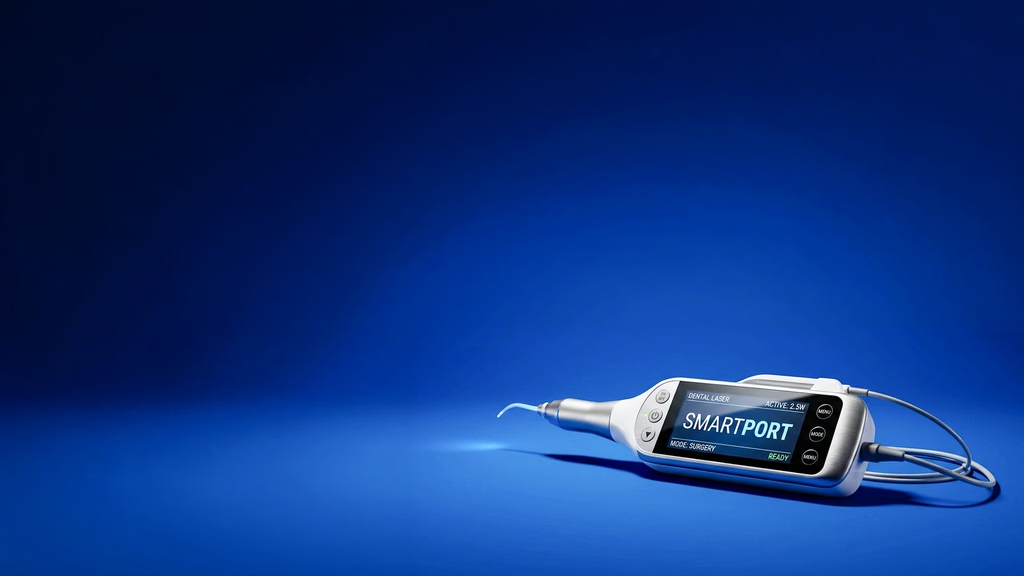
Is a coined word made up of two English terms sufficient to obtain trademark protection for dental equipment and medical technology? And does it help that such products are purchased almost exclusively by professionals? The Federal Patent Court answered “no” to both questions and denied trademark protection in Germany to the word mark SMARTPORT.
A trademark for drills, lasers, and dental chairs
The SMARTPORT word mark is registered in Switzerland. On September 11, 2017, it was also registered internationally. An international registration under the Madrid System allows a home country trademark to be extended to other countries with a single application. However, each designated country decides for itself whether to grant protection to the trademark. In Germany, the German Patent and Trademark Office (DPMA) is responsible for this.
The trademark owner sought protection for goods in the medical and dental technology sectors. These include electrical control and measuring devices, dental equipment, surgical instruments, dental lasers, X-ray machines for dental imaging, and dental drills. In addition, there are medical vacuum pumps, LED lights and light guides, as well as sterilizers for dental instruments.
In decisions dated December 16, 2019, and August 3, 2022, the DPMA denied trademark protection for the majority of these goods. The only exceptions were dental mirrors, dental examination chairs, and patient treatment chairs. In the Office’s view, the public perceives SMARTPORT as an intelligent data gateway. In medical technology, the mark is also an abbreviation for an intelligent port catheter, i.e., an implanted catheter system.
The trademark owner’s objections
The trademark owner filed an appeal against the refusal of protection. She argued that while “smart” is used for everyday products, it is not used for medical devices. There was no evidence whatsoever of the use of “Port” to mean an interface in connection with her goods. SMARTPORT was a coined term with no reference to the characteristics of the goods.
Furthermore, ports are simple components that are not intelligent in and of themselves. In any case, the abbreviations “AI” and “KI” have become established for products featuring artificial intelligence. The medical professional audience expects the devices to be networked and therefore interprets the symbol as an indication of origin. Finally, the DPMA has registered numerous trademarks containing the elements “Smart” and “Port.”
Federal Patent Court Rejects Appeal
The Federal Patent Court dismissed the appeal by order dated October 7, 2026—Case No. 28 W (pat) 63/22. The court found that the trademark lacked any distinctiveness for all the goods in question. Distinctiveness refers to a trademark’s ability to identify goods as products of a specific company. The court left open the question of whether the designation must also be kept free for competitors.
What does “smart” mean to the public?
The standard of examination is generous in itself. Even a low degree of distinctiveness is sufficient for trademark protection. However, distinctiveness is lacking if the public primarily associates a word with a descriptive meaning. The relevant understanding is that prevailing at the time of international registration—in this case, September 2017.
The court first examined the two word elements separately and then assessed the mark as a whole. This approach is permissible, as we have already described in the VARIOPILOT case. “Port” refers to a passageway or access point. In information technology, it refers to an interface through which a connection is established. In medicine, “port” is also commonly used as a shortened form for a port catheter.
“Smart” has long been used in Germany as a positive attribute, for example, to mean clever, smart, or particularly innovative. In the technical field, it refers to electronic networking or an additional intelligent function. In this regard, the court cites its own earlier decisions regarding marks such as SmartGrill and SMARTCORE. The hyphenated form is customary in advertising and follows the pattern of well-known words such as “smartphone.”
Given that the term “SMART” was already in nearly ubiquitous use as of the priority date and that its scope of application is suitable for almost any product claiming to be innovative, it is highly unlikely that the relevant public could derive any comprehensible, factual meaning from the term “SMARTPORT” in the context of the relevant goods, as the IR trademark owner claims, could not derive a comprehensible, factual meaning from it.
The reference to artificial intelligence didn’t catch on either. “Smart” does not necessarily imply AI in the strict sense. “Smart” processes are also conceivable when a device evaluates data, updates itself, or communicates with other systems according to preprogrammed rules. The court demonstrated that “Smartport” had already been used in this sense prior to 2017, citing, among other things, a German patent application for power tools.
Does the technical audience help with trademark protection?
The court answers this question in the negative. Even for specialized technical products, the term “smart” is frequently used in advertising. Since the expert audience expects a “smart” design in any case, it would view “SMARTPORT” all the more as merely a clarifying factual statement. Even a reference to something that goes without saying is descriptive and does not indicate origin.
For each product category, the court identified specific points of reference. In dentistry, systems that connect practice software to lasers, digital X-ray machines, or intraoral cameras were already known as early as 2017. Suction pumps could transmit operational data to central systems. Sterilizers could output data for batch documentation. For electrical medical devices, the court also refers to a safety standard that imposes specific requirements on connections.
The fact that “SMARTPORT” can be interpreted differently depending on the goods did not help the trademark owner. Even if all conceivable meanings are descriptive, the mere effort required to interpret the trademark is not sufficient to establish distinctiveness. Our article “No Trademark for OPENAI” also illustrates how ambiguous marks fail to meet this standard.
Why don’t earlier “smart” trademarks help?
The trademark owner had cited registered trademarks containing “Smart” or “Port.” The court countered that some of these were word-and-design trademarks—that is, trademarks containing graphic elements. Others dated from 2000 and 2001 and were therefore of little significance. Similarly, a large number of marks containing these elements could be cited that had been deemed ineligible for protection.
In principle, prior registrations do not give rise to a right to registration. Nor does the principle of equal treatment alter this. Each application must be assessed solely in accordance with the legal requirements.
Conclusion
This decision is consistent with a series of earlier decisions regarding “smart” marks, to which the court itself refers. In our view, anyone relying on a buzzword in trademark law will, at best, be able to obtain protection only through a distinctive graphic or linguistic design. It is noteworthy that the specialized customer base did not provide any relief.
We take a critical view of how heavily the rationale relies on possibilities. Devices could have ports, transmit data, or meet a security standard. This allows for a descriptive connection to be made to virtually any electrical device. The resolution does not address where the line is drawn between this and a mere allusion, which, under the broad criteria, would still allow for protection.
We’d be happy to
advise you on
trademark law!