

Detergent
that looks like
Juice.
Detergent
that looks like
Juice.
by
Can a laundry detergent be sold in a carton that resembles a milk or juice carton, provided it bears a seal and a warning not to drink the contents? And does a manufacturer have to worry that packaging designed to look like food packaging might be banned in one country but not in another?
Laundry Detergent in a Beverage Carton
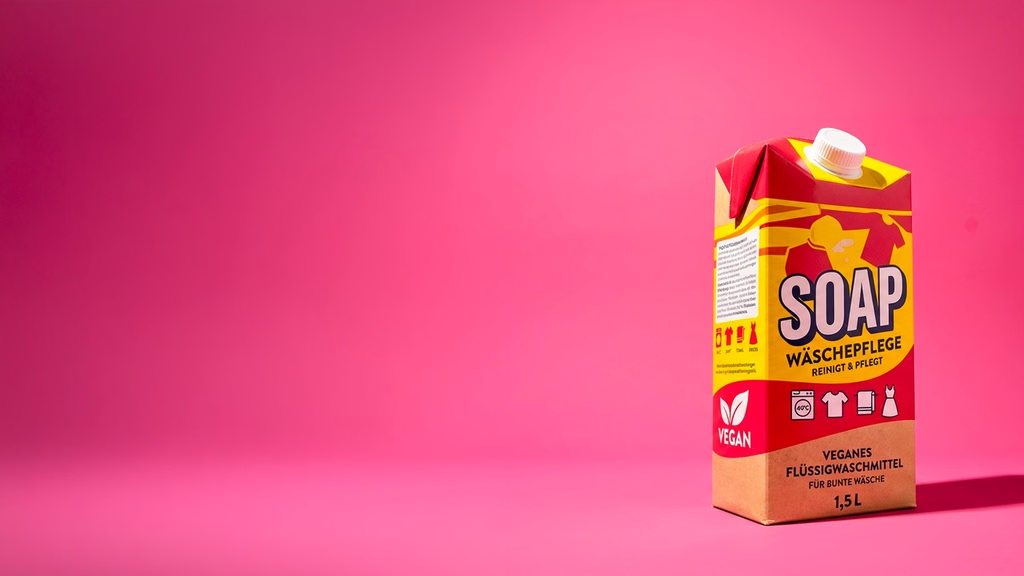
The Swedish company Orkla Care sells liquid laundry detergent. The packaging consists of colored cardboard. It is elongated, has a folded lid, and features a screw cap on one side. Anyone who shops at the supermarket is familiar with this shape, especially from the refrigerated aisle.
Consumers brought the similarity to the attention of the Swedish Chemicals Agency. The agency heard the company’s side of the story and subsequently banned the sale of nine laundry detergents in this packaging. The decisive factors for the agency were the shape and appearance of the box, the colors, the label, and the claim that the product was vegan.
The company disputed this. It argued that the box depicted textiles, not food. A seal must be removed before first use. A warning label states that the contents must not be swallowed. The detergent merely irritates the eyes and is harmless if swallowed. They chose the cardboard box for environmental reasons.
The Nacka Environmental Court of First Instance upheld the ban. It ruled that the packaging could be mistaken for that of milk, yogurt, or fruit juice and would arouse children’s curiosity. The Stockholm Court of Appeals referred the matter to the Court of Justice of the European Union.
The Legal Issue at Hand
The CLP Regulation—that is, the EU Regulation on the Classification, Labeling, and Packaging of Substances and Mixtures—is the governing legislation. Among other things, it specifies how chemicals sold to consumers must be packaged. Such packaging must not arouse children’s curiosity or mislead consumers. Nor may it be designed to resemble packaging for food, animal feed, medicines, or cosmetics if doing so would mislead consumers.
The detergent is classified as hazardous, specifically as an eye irritant. This classification was not disputed by the parties involved. The Swedish court sought to determine the criteria by which the similarity should be assessed. It also inquired about the relevant market, the definition of a consumer, the necessary risk of deception, and the role of the type of hazard.
ECJ Clarifies the Standards
In its judgment of November 5, 2026—Case No. C-395/25 —the Court of Justice answered all five questions. This is a preliminary ruling proceeding. In its ruling, the Court of Justice interprets only Union law. Whether the specific packaging is permissible is a matter for the Swedish Court of Appeals to decide on its own. The main proceedings are therefore still pending.
When does packaging look like food?
The decisive factor is the overall impression of the packaging, not a single characteristic. By using terms such as “presentation” and “design,” the legislature intended to encompass all perceptible characteristics. In particular, the following should be examined: shape, size, volume, design, color, label, material, surface, and smell—including how they interact. These are the characteristics by which the public typically recognizes food.
The assessment is conducted on a case-by-case basis. In doing so, the objective of the regulation—to ensure a high level of protection for human health—must always be taken into account. With regard to the Swedish case, the Court of Justice specifically cites the elongated brick shape, the use of cardboard as the material, the color combination, and the information on the packaging.
Why aren’t seals and warning labels effective?
According to the ruling, a safety feature is only considered valid if it remains intact throughout the entire service life of the packaging. The seal on the screw cap is torn off when the package is first opened. The Court points out that packaging for hazardous products must be durable under normal handling conditions. For the outer packaging of laundry detergent in soluble single-use portions, the regulation even explicitly requires a closure that functions throughout the entire service life. It follows from this that a safety label must also remain effective for as long as the product is kept in the household.
Since this type of product is used regularly and is therefore present in households over the long term, the purpose of this label does not cease to apply after the product has been used for the first time.
Protection is not limited to the buyer in the store, but extends to anyone who uses the product later. The risk of confusion exists both at the time of purchase and weeks later in the bathroom or kitchen.
Even the warning not to swallow the contents does not save the packaging. Such warnings are required by law anyway. In the court’s view, they do not necessarily offset the immediate visual impact of food-like packaging. When someone sees a juice carton, they rarely read the fine print first.
Who is considered a consumer?
The term should be interpreted broadly. It encompasses the average, well-informed, and attentive consumer, as well as children and vulnerable individuals. The regulation does not refer to the average consumer, but rather to packaging intended for the general public. In addition, it requires tactile hazard warnings on certain types of packaging for people with visual impairments.
In practice, this means a shift in perspective. It is not enough for an observant adult to recognize the difference. What also matters is how a child or a person with low vision perceives the packaging.
Can each country decide differently?
Yes, the authority of a Member State may base its decision on the circumstances in its own country. According to the ruling, it is not required to examine whether the packaging is also considered misleading in other Member States.
The Court of Justice bases its response on the structure of market surveillance. National authorities are responsible for products within their territory. The risk of deception depends on how local consumers perceive the packaging. If the packaging resembles a product that is well-known in that country, that is sufficient. Although the criteria are the same throughout the Union, the outcome may vary depending on the market.
Of particular note is a reference to the EU Market Surveillance Regulation. According to this regulation, a decision by an authority that a product is noncompliant gives rise to a presumption that is also binding on the authorities of other Member States. However, another authority may rebut this presumption by issuing a contrary decision based on its own investigation. A ban in one country can therefore have an impact on other markets, without the same outcome automatically applying there.
Does the nature of the hazard matter?
No. The company had argued that its laundry detergent was dangerous only to the eyes and harmless if ingested. Therefore, mistaking it for juice would not pose the risk in question. The court did not accept this argument. The packaging regulations apply equally to all hazardous substances once they are classified as such. They are intended to prevent any hazardous contact with chemicals that could result from confusion, including eye irritation. During the proceedings, the company also acknowledged that the surfactants contained in the product could temporarily cause nausea and vomiting.
According to the ruling, it is sufficient for the degree of risk to be more than negligible. The authority is not required to prove that actual mix-ups have occurred. Such cases may serve as an indication, but their absence does not exonerate the authority.
Conclusion
The Court rejects the option of tear-off seals and warning labels as a solution. For manufacturers of household chemicals, packaging design thus becomes a matter of product safety and not just marketing.
We view the consequences for the single market with concern. The CLP Regulation harmonizes labeling and packaging so that chemicals can circulate freely. However, if each authority makes judgments based on the visual norms of its own market, the same packaging could be permitted in one country and banned in a neighboring one. The Court of Justice does not see this as a contradiction because the criteria are uniform. Nevertheless, legal certainty remains limited for a company that uses the same packaging in many countries.
We’d be happy to
advise you on
Competition law!