

Copying Photos
using
generative AI.
Copying Photos
using
generative AI.
of
How far does the protection of a simple product photo extend if competitors have it edited or replicated using AI? Who is actually responsible for proving that an AI-generated image is indeed based on one’s own photo?
What it’s about
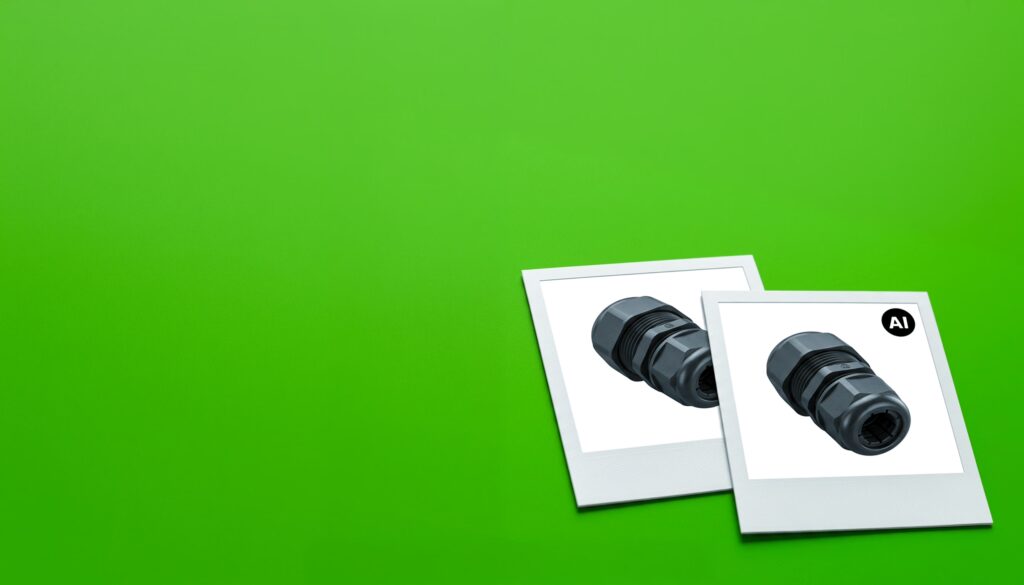
An entrepreneur has been developing and selling cable glands made of thermoplastic polyurethane for photovoltaic systems since 2022. Since 2024, he has been offering his products under his own brand name on ebay.de, using custom-made product photos. In April 2025, he noticed that a competitor was advertising a very similar product on the same platform, with images that strikingly resembled his own photos.
To support his suspicion, the plaintiff conducted his own experiment. He uploaded one of his product photos to ChatGPT and asked the AI to create a realistic or “clean” rendered version of it. The result resembled the image used by the competitor. From this, the plaintiff concluded that the competitor must have fed his original photo into an AI system and adopted the result. The plaintiff also believed that a second image used by the competitor on June 1, 2025, was an AI-edited version of one of his photos—in this case, a computer-generated rendering from a CAD drawing program.
Following an unsuccessful cease and desist letter and a partially successful preliminary injunction regarding other competition law violations, the plaintiff filed a lawsuit in the Frankfurt am Main Regional Court seeking an injunction, disclosure of information, and reimbursement of his legal costs for copyright infringements. The competitor denied ever having used the plaintiff’s photos and submitted its own original photographs, which, according to the competitor, had served as the basis for the AI processing.
What the Court Ruled
The Regional Court of Frankfurt am Main dismissed the lawsuit in its entirety, with Judgment of May 27, 2026 – Case No. 2-06 O 347/25 from.
First, the court distinguished between the two images. It held that the computer-generated CAD image was not a protected photograph because it did not depict an actual event but had been generated on a computer screen. Furthermore, broader protection as a creative work was ruled out because the image served purely technical purposes and the plaintiff had no significant creative leeway in its creation.
The situation was different with regard to the actual photograph of the cable feed-through on the plaintiff’s roof. This photograph is, in principle, protected as a simple photographic image. However, the image does not qualify for the higher level of protection afforded to a photographic work, which requires a greater degree of creative effort. The framing and angle of the shot are clearly determined by the purpose of showing the cable feed-through in use, rather than by a free creative decision on the part of the photographer.
Evidence Issues
The decisive issue then became whether the competitor had actually used this photo at all. Here, the court expressed skepticism regarding the plaintiff’s line of evidence. The fact that an AI could generate a result similar to the competitor’s image from the plaintiff’s own photo did not necessarily mean that the competitor had actually chosen to do so. The competitor had submitted its own original photos, from which, in the court’s assessment, the disputed image could just as easily have been derived. The plaintiff had not offered any evidence to support his claim that the competitor had fed his image into the system. His own experiment with the chatbot was not sufficient proof.
In this case, the plaintiff was unable to prove, to the satisfaction of the court, that the defendant had even used the plaintiff’s images when creating her own.
No infringement
Even if one were to assume, in favor of the plaintiff, that the competitor had in fact used his photo, the court did not view this as an infringement of his rights. In a direct comparison, the images differed in several respects, which the court deemed sufficient: a different framing, a wider gap in the roof tile, differently positioned cables, a different position of the colored cable, and distinct color differences in the tiles. Since simple photographs are entitled to only a narrow scope of protection—which essentially covers identical or only slightly modified reproductions—these differences were sufficient to render the original photo unrecognizable in the modified version. In reaching this conclusion, the court relied on a standard previously established by the European Court of Justice and a Higher Regional Court in comparable AI cases. According to this standard, an edited work can only be challenged under copyright law if the creative characteristics of the original are still recognizable in the new version and it can be proven that these characteristics were taken from the protected work, rather than merely coincidentally resembling it.
The court expressly left open the additional question raised by the plaintiff as to whether simply feeding his photo into an AI system should be considered an unauthorized reproduction. For one thing, the plaintiff had not included this allegation in his complaint, so the court was not authorized to rule on it. For another, it was irrelevant in any case, because it had not even been established that the competitor had uploaded the photo to an AI system at all.
Practical Questions Arising from the Ruling
The decision raises several points that go beyond the specific case.
For one thing, the ruling highlights a significant gap in the evidence to the detriment of photographers and rights holders. Anyone who suspects that a competitor has used their own image as the basis for AI editing can hardly prove it as long as the opposing party plausibly presents its own source photos. The obvious approach—running one’s own image through AI as well and using the similarity of the results as evidence—was deemed insufficient by the court. Whether and how such proof can be successfully established at all—for example, through technical analysis of image data or metadata—remains unclear following this ruling.
On the other hand, the ruling effectively narrows the scope of protection for functional product photography. Anyone who takes photographs for practical reasons—such as to show a product in use—is already entitled only to the weaker protection afforded to photographs. If such a photo is additionally altered by AI, this ruling holds that even relatively minor deviations are sufficient to fall outside the scope of protection. In practice, this is likely to mean that competitors can deviate from a template with relatively little effort, provided they have their own source material or can present such material.
Ultimately, the fundamental question remains unanswered: Does simply feeding a protected photo into an AI system already constitute reproduction—for example, because the image remains stored or accessible in the model in some form? In this regard, the court refers to a comparable issue—one that has also not yet been conclusively resolved—from a Munich case involving ChatGPT. Until this issue is resolved by the highest court, it remains unclear to photographers whether they can take legal action against the training or use of their images in AI systems as such, regardless of the visible end result.
Conclusion
The ruling reveals a structural problem that extends far beyond this individual case. As long as generative AI is capable of producing similar-looking results from very different source images, it will be extremely difficult for those affected to prove that their image was actually used, even when suspicion is warranted.
In practical terms, however, this also means that functional product photography—which is ubiquitous in e-commerce—could be comparatively vulnerable to AI-driven imitation. The court deliberately left open the actually intriguing question of whether feeding third-party photos into AI systems in and of itself constitutes an infringement of third-party laws. Until this question is clarified, the issue of evidence is likely to determine the outcome in comparable cases more often than the actual copyright assessment.
We are happy to
advise you about
Copyright!