

Metal
on
metal.
Metal
on
metal.
of
Sampling Wins Case Before the Federal Court of Justice: After a 27-year legal battle, the Federal Court of Justice rules that the “Kraftwerk” sample is permissible.
Federal Court of Justice Ends Power Plant Sampling Marathon
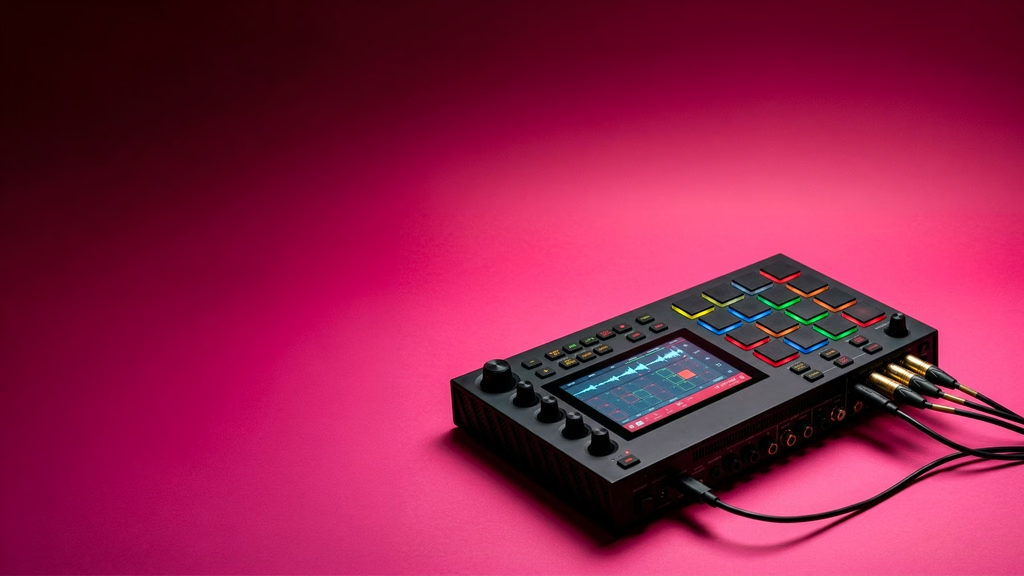
A two-second rhythm, a twenty-seven-year legal battle: Since 1999, Kraftwerk has been fighting Moses Pelham over a tiny sample from “Metall auf Metall.” The case went through five proceedings at the Federal Court of Justice (BGH), ended up at the Federal Constitutional Court, and was brought before the European Court of Justice twice. Now the Federal Court of Justice has had the final say, and Moses Pelham has been vindicated.
A sample that made music history
Kraftwerk released the track “Metall auf Metall” in 1977. Twenty years later, the producers of Sabrina Setlur’s song “Nur mir” copied two seconds of a rhythm sequence from it and used it as a continuous loop beneath the track without permission. Kraftwerk viewed this as an infringement of their rights as record producers and performing artists and demanded a cease-and-desist order, damages, and the destruction of the recordings. The Hamburg Regional Court ruled in their favor in 2004; thereafter, the case was heard over the course of two decades by several Higher Regional Courts, the Federal Court of Justice (BGH) on five separate occasions, the Federal Constitutional Court, and finally the ECJ.
Pastiche Instead of Infringement
In its ruling of September 3, 2026 (Case No. I ZR 74/22), the Federal Court of Justice confirmed that, while the adaptation infringes on the plaintiffs’ reproduction rights, it is permissible as a pastiche within the meaning of the Copyright Directive. This was based on the interpretation by the ECJ on April 14, 2026, according to which a pastiche recalls an existing work, is at the same time perceptibly different from it, and engages in an artistic dialogue with it.
The exception for pastiches covers works that are reminiscent of an existing work but exhibit discernible differences and engage in a recognizable artistic dialogue with it.
The new work must be recognizable as a reference to the original while at the same time distinctly setting itself apart from it. It is also essential that the elements borrowed—including through sampling—be used to foster a genuine artistic dialogue with the original, whether as an overt stylistic imitation, an homage, or a humorous or critical engagement with it.
This artistic dialogue does not have to be immediately apparent to every listener. It is enough if someone familiar with the original work can recognize the reference.
Conclusion
With this ruling, the concept of pastiche finally takes shape and opens up noticeably more creative freedom for music production when it comes to sampling. For creators, this means more leeway; for rights holders, it means tighter limits on their exclusive rights. “Metall auf Metall” thus remains what it has long been: a landmark ruling in German copyright law with implications for the entire European music industry.
We’d be happy to
advise you on the
Copyright!