

Swissness:
Judgment stops
Label fraud.
Swissness:
Judgment stops
Label fraud.
from
Is a letterbox in Zug enough to be called “Swiss”? And why did Toblerone have to remove the Matterhorn from its packaging? A landmark ruling from Bern on Swissness shows how seriously Switzerland takes the protection of Swiss names and symbols.
IPI successfully enforces Swissness
On 08.01.2026, the Swiss Federal Institute of Intellectual Property (IPI ) announced a remarkable success against a financial services provider BDSwiss AG. BDSwiss AG was ordered by the Commercial Court of Bern to remove the word “Swiss” from its name and to remove the Swiss cross from its logo. This ruling impressively demonstrates how seriously Switzerland takes the protection of its national symbols and the designation “Switzerland” – a protection that does not exist in this form in Germany or the European Union.
What was it about?
BDSwiss AG is an international financial services provider that offers CFD trading and similar financial products. The company was founded in 2012 under the name “Banc de Swiss” and its services are primarily aimed at customers in Germany. Although BDSwiss AG has a business address in Zug, Switzerland, the company is actually managed from Cyprus, where the group’s headquarters are also located.
This is precisely where the problem lies: under Swiss law, it is not enough to simply have a formal registered office in Switzerland to be able to call yourself “Swiss”. In its ruling, the Commercial Court of Bern stated unequivocally that “nothing more happens at the location in Zug than just the letterbox being emptied”. Such a mere letterbox company does not meet the requirements of Swiss Swissness legislation.
After several complaints were received against BDSwiss AG in Switzerland, the IPI took action and filed a lawsuit with the Commercial Court of Bern. The ruling of August 26, 2025 is now legally binding. The company now has three months to adapt its entire public image – this applies to the company name as well as all logos and advertising materials.
What does Swissness actually mean?
Behind the term “Swissness” lies a globally unique concept for protecting the national designation of origin. Switzerland has recognized that the “Switzerland” label represents considerable economic value: Studies show that consumers are willing to pay more for Swiss products and services.
In order to protect this valuable reputation, Switzerland has had Swissness legislation in force since 01.01.2017. It is enshrined in the Trademark Protection Act and sets out in detail the criteria that products and services must meet in order to be advertised as “Swiss”. Anyone who does not comply with these rules may not use the Swiss cross or other Swiss symbols – and terms such as “Swiss”, “Made in Switzerland” or “Swiss quality” are then also taboo.
Which symbols and designations are protected?
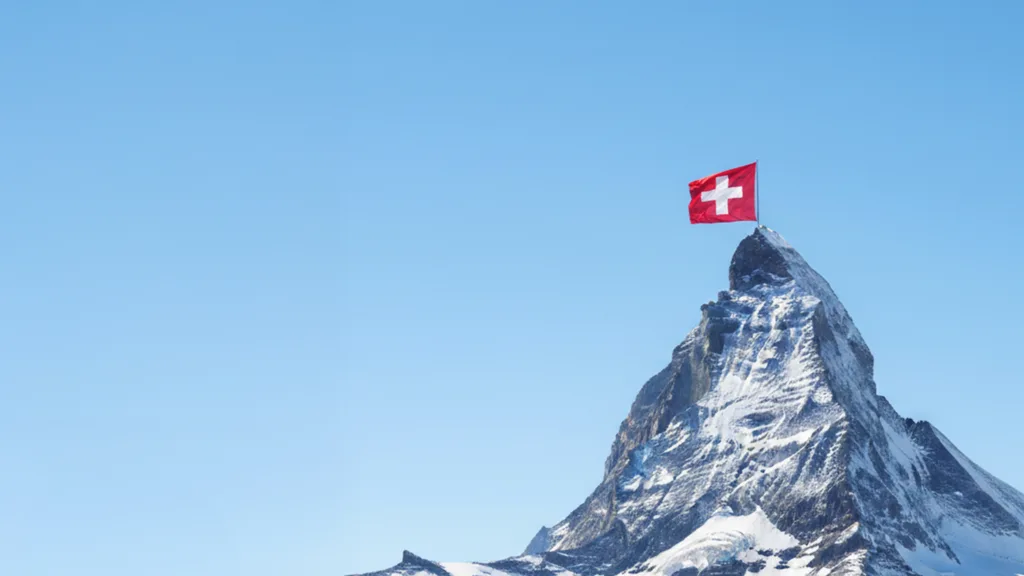
Swissness legislation goes far beyond the Swiss cross. All direct and indirect references to Swiss origin are protected. This includes textual designations such as “Switzerland”, “Swiss”, “Made in Switzerland”, “Swiss quality” or “Swiss Made”. But pictorial representations are also included: The Swiss cross, of course, but also images of the Matterhorn, the figure of William Tell, the crossbow, Helvetia or other symbols that are considered typically Swiss.
It is important to distinguish between the Swiss cross and the Swiss coat of arms. The Swiss cross (the white cross on a red background without a shield) may be used by companies for products and services as long as they meet the Swissness criteria. The Swiss coat of arms (the Swiss cross on a triangular shield), on the other hand, is reserved exclusively for the state and its authorities. Private companies are not allowed to use it.
A prominent example: Toblerone and the Matterhorn
Just how consistently Switzerland enforces its Swissness rules was demonstrated in 2023 by the example of the world-famous chocolate brand Toblerone. When the US parent company Mondelez announced that it would be relocating part of its production from Bern to Slovakia, this had immediate consequences: The iconic Matterhorn, which had adorned the packaging since 1970, had to disappear from the pack and was replaced by a stylized, unspecific mountain. The slogan “of Switzerland” was also changed to “established in Switzerland”.
The reason: A particularly strict industry agreement applies to chocolate as a dairy product – all production steps must be carried out 100% in Switzerland if the product is to be sold as “Swiss milk chocolate”. Due to the partial production in Slovakia, Toblerone was no longer able to meet this requirement.
The Swissness rules at a glance
Switzerland distinguishes between different product categories when it comes to the requirements. For foodstuffs, at least 80 percent of the raw material weight must come from Switzerland, for milk and dairy products even 100 percent. In addition, the main processing step must take place in Switzerland – for example, the processing of milk into cheese.
For industrial products such as watches, machines or knives, at least 60 percent of the manufacturing costs must be incurred in Switzerland. Research and development costs are also taken into account. In addition, the manufacturing step that gives the product its essential characteristics must take place in Switzerland. For the watch industry, where the “Swiss Made” label is particularly valuable, additional requirements apply due to a special industry ordinance.
In the case of services – and this is the core of the current ruling – two conditions must be met: The place of business must be in Switzerland and the company must actually be managed from Switzerland. A mere postal address or letterbox is expressly not sufficient. The company must be able to prove that the main business decisions are actually taken from Switzerland.
What does the ruling mean?
According to the IPI, the ruling is the first time that the Swissness criteria for claiming services as Swiss have been confirmed in court. It is particularly noteworthy that the requirements were interpreted strictly – and for a company that is present in Switzerland and provides financial services, but whose headquarters are abroad.
The ruling sends a clear signal to companies: Anyone wishing to benefit from Switzerland’s excellent reputation must actually do business there. A letterbox company is not enough. This signal is particularly important in the financial services sector, where Switzerland has an international reputation for integrity, stability and reliability.
Conclusion
With its Swissness legislation, Switzerland pursues a globally unique approach to protecting Swiss names and symbols. There are no comparable legal regulations in Germany or the EU.
The economic background is clear: the “Swiss trademark” is worth billions. Swiss products are associated worldwide with quality, precision, reliability and exclusivity – be it watches, chocolate, cheese or financial services. Switzerland wants to protect this reputation and is doing so with remarkable consistency.
For companies that want to advertise with Switzerland, this means A genuine presence and actual economic activity in Switzerland are essential. Companies that are unable or unwilling to meet these requirements should refrain from using Swiss symbols and designations – otherwise there is a risk of legal consequences. For all companies that legitimately meet the Swissness criteria, however, the strict regulations are an advantage: they protect the value of their Swiss origin from dilution by free riders in the long term.
We are happy to
advise you about
Trademark law!