

Rummage table
Instead of
Luxury.
Rummage table
Instead of
Luxury.
of
Can luxury cosmetics be sold between bargain bins and cheap goods? When does the presentation of goods damage the brand image to such an extent that the principle of exhaustion no longer applies? And what does this mean for retailers who rely on remaining stock and bargains?
What was it about?
The German distribution company of the L’Oréal Group sells cosmetic products from the trademarks Yves Saint Laurent, Lancôme and IT Cosmetics via a selective distribution system. The selected retailers must adhere to strict presentation and sales environment requirements in order to maintain the exclusivity and prestigious image of the trademarks.
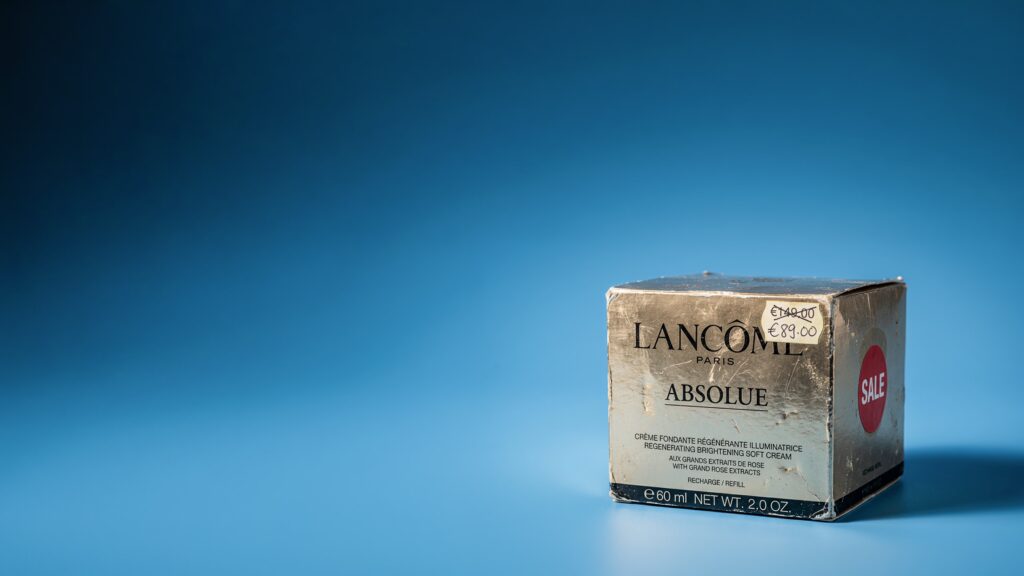
TK Maxx, the German subsidiary of an international off-price retailer, offered these branded products in its stores. During test purchases in several stores in August and September 2024, L’Oréal Luxe documented the actual product presentation. The cosmetic products were displayed in unsorted sales boxes together with items from other manufacturers, some of which were in significantly lower price segments. Some packaging was torn, others bore manually altered price labels.
Following an unsuccessful cease and desist letter for trademark infringement, the Düsseldorf Regional Court issued a temporary injunction in October 2024 prohibiting TK Maxx from selling the product in this form. TK Maxx lodged an appeal.
Treasure hunt or rummage sale?
TK Maxx has defended itself with a number of arguments. The principle of exhaustion applies and the conditions for an exception are not met. The trademarks already lacked a special prestige value. In addition, a rampant gray market for the products concerned is flourishing, which speaks against a functioning selective distribution system. L’Oréal itself advertises the products with discount campaigns.
With regard to the sales concept, TK Maxx explained that it is not a discount store, but offers customers the shopping experience of a “treasure hunt” for luxury products. Isolated cases of disorder were due to customer behavior and were not representative of the overall concept. The three documented cases of damaged packaging are regrettable isolated incidents.
What did the OLG Düsseldorf decide?
The Düsseldorf Higher Regional Court dismissed the appeal with Judgment of 10.02.2026 – Ref. I-20 U 89/25 and confirmed the preliminary injunction in its entirety.
Prestige character of the trademarks confirmed
The court found that the trademarks Yves Saint Laurent, Lancôme and IT Cosmetics have a considerable prestige value and a certain “aura of luxury”. L’Oréal Luxe has credibly demonstrated that the products are in the upper price segment, are advertised using prominent brand ambassadors and are distributed via a selective distribution system with strict presentation criteria. The members of the Senate, as part of the relevant public, confirmed this prestigious character from their own knowledge.
The court did not accept the objection of a rampant gray market. The screenshots submitted by TK Maxx only showed isolated offers from which no systematic parallel distribution could be derived. Moderate discounts of 15 to 25 percent on individual products were also common in the luxury segment and did not call the prestige value into question.
Rummage table destroys the “aura of luxury”
The core of the decision is the assessment of the specific presentation of goods. The court analyzed the typical flow in the TK Maxx sales chutes and came to the conclusion that the increasing disorder is not a series of regrettable individual cases, but the inevitable consequence of the sales concept. Without a constant, orderly deployment of staff, the chutes inevitably end up in a state of disorder with small cosmetic items, which gives the customer the impression of a rummage table.
The court expressly stated that it did not matter whether TK Maxx was generally perceived as a low-cost discounter or an off-price store. Only the specific product presentation was decisive. And this gave the impression that the products could no longer be sold via specialist retailers and therefore had to be “sold off”.
Offering branded goods in a rummage sale does not fit in with an “aura of luxury” and is therefore likely to cause lasting damage to its prestige value.
The Düsseldorf judges were not convinced by the “treasure hunt” argument. In the eyes of the consumer, a rummage sale is not associated with the search for treasures, but with the sale of surplus goods. As a result, the trademarks appear to be in decline, sinking from the upmarket segment into the field of mass-produced goods.
Damaged packaging as a separate offense
In addition, the court confirmed the ban on selling cosmetic products of the Yves Saint Laurent trademark in damaged packaging or packaging with handwritten price labels. The Senate qualified this as a deterioration or change in the appearance of the goods, which has a lasting negative impact on the image of the trademark. Here, too, the court did not see an isolated case, but an inherent consequence of the distribution model. Rummaging through boxes almost inevitably leads to damage to goods packaged in cardboard boxes.
The legal framework
The decision is in the area of conflict between the principle of exhaustion under trademark law and the protection of the trademark image. According to the principle of exhaustion, trademarked goods that have been placed on the market in the European Economic Area with the consent of the owner may, in principle, be freely resold. However, the principle of exhaustion contains an exception for cases in which “legitimate reasons” justify the trademark owner’s objection, in particular if the condition of the goods has been altered or deteriorated.
The ECJ has clarified that the quality of prestige goods is not based solely on their material characteristics, but also on their prestigious character, which gives them a “luxurious aura”. Damage to this aura therefore impairs the quality of the goods themselves.
Conclusion
The decision confirms that selective distribution systems are an effective instrument for protecting the brand image. Those who consistently enforce their distribution system, take action against gray market activities and document the presentation requirements can also successfully invoke the exception that excludes exhaustion against large retailers.
Anyone offering luxury and prestige products outside authorized distribution channels must pay attention to the presentation. Distribution as such is not prohibited. The decisive factor is that the presentation of the goods does not detract from the prestige character of the trademark. Rummage tables and unsorted sales piles are taboo for luxury cosmetics.
The ruling does not make a fundamental statement against the off-price business model. TK Maxx was not prohibited from selling in general, but only from offering specific products. There is therefore still room for the sale of luxury products in the off-price segment, provided that an appropriate presentation is ensured.
We are happy to
advise you about
Trademark law!