

No trademark
for
Pico-Balla.
No trademark
for
Pico-Balla.
of
Can the shape of a fruit gum be legally protected? What does a sweet have to have for its shape to be considered a trademark? And why is decades of market presence alone not enough?
The Pico-Balla and its path to the EUIPO
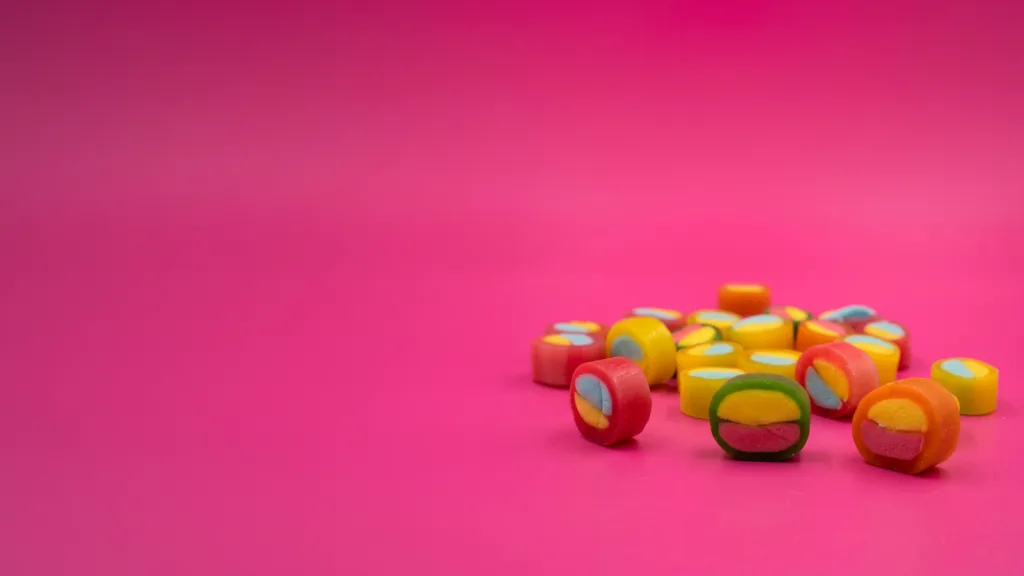
Pico-Balla is one of HARIBO’s best-known products. The round fruit gum with a green outer ring and a two-part fondant filling has been marketed since 2000. HARIBO itself describes the product as difficult to imitate because its combination of chewing gum wrapper and double confectionery filling is unique. The company wanted to protect this uniqueness under trademark law.
In October 2024, Rigo Trading S.A., a member of the HARIBO Group, registered the three-dimensional shape of the sweet with the European Union Intellectual Property Office (EUIPO) as an EU trademark. The sign shows a cylindrical sweet with a green outer ring and two differently colored inner surfaces, a yellow and a pink-red segment, separated by a green line. In November 2024, the examiner responsible raised concerns. The shape did not deviate sufficiently from the usual shape expected on the confectionery shelf.
What a 3D trademark must achieve
Under European trademark law, not only words or logos can be registered as trademarks, but also three-dimensional shapes. The catch is as follows. If the shape is the shape of the product itself, trademark law sets particularly high requirements.
The reason lies in consumer behavior. People are used to recognizing a product by its name or logo. They do not usually perceive the simple shape of a sweet as an indication of a specific manufacturer. Therefore, such a shape can only be considered a trademark if it clearly stands out from the usual and is so unmistakable that the buyer can infer the manufacturer from the shape alone. Novelty or an original idea are not sufficient.
What HARIBO presented
HARIBO argued on several levels. First, the company denied that confectionery had a typical shape at all. Since sweets can be produced in countless shapes, the shape of the Pico-Balla could not be classified as a product shape at all. Furthermore, the shape is simply unique because no other product on the market combines three different colors with an outer ring and two clearly separated inner segments.
As evidence, HARIBO submitted, among other things, a German trademark registration from 2000 that protects the same sign. The company also submitted two consumer surveys. A survey from 2020 showed that more than 58 percent of respondents in Germany knew the Pico-Balla and associated it with HARIBO. A more recent survey from March 2025 even found that 79 percent of 1,000 people surveyed associated the shape of the sweet with HARIBO and the Pico-Balla. Finally, HARIBO referred to several trademarks already registered with the EUIPO for other simple geometric shapes, which also have little in common.
In addition, the company requested that the proceedings be provisionally suspended because similar proceedings relating to other color variants of the Pico-Balla are pending at the EUIPO at the same time.
The target group will perceive the green outline as the outer shape of the sweet and the two inner segments separated by a green line as a demarcation of the filling of the sweet into two different flavors.
The decision of the Board of Appeal
The 5th Board of Appeal of the EUIPO (Decision of 06.03.2026 – Ref. R 1517/2025-5 ) dismissed the appeal. It rejected the application for a stay because the legal situation regarding three-dimensional trademarks was clear and well established and no open questions of principle remained.
In terms of content, the Board did not see sufficient distinctiveness. It justified this essentially on the basis of three considerations.
The colors convey taste, not manufacturer. Green stands for apple or lime, yellow for lemon, pink for strawberry or cherry. Colorful sweets are widely available on the confectionery shelves because colors whet the appetite and appeal to children in particular. Whether a sweet has two or three colors does not make any significant difference.
The division into segments is also explained by the contents. When you see the inside of a sweet split in two, you think of two different flavors, not one manufacturer. The green dividing line reinforces this impression.
The round shape without sharp edges is simply one of the many basic shapes in which sweets are produced. The chamber reminded us that confectionery can come in rectangles, balls, rings, diamonds or cubes. The rounded shape of the pico-balla is one of these variants.
Although the Board took the consumer surveys into account, it assigned them to the wrong examination step. At most, they could become relevant in the context of what is referred to as “trade acceptance”, i.e. when it is proven that a sign has only become a trademark through intensive use. They play no role in the question of whether the sign is inherently suitable as a trademark.
The German trademark registration did not help HARIBO either. The European trademark system is independent and not bound by national decisions. And the reference to similarly simple registered EU trademarks of other applicants did not convince the Chamber either. Anyone who is aware of a registration that may have been wrongly granted cannot derive a claim to equal treatment from it.
What happens next
The proceedings have not yet been concluded. HARIBO had already opened a second avenue at an early stage as a precautionary measure. The company had argued in the alternative that the shape of the Pico-Balla had become a trademark due to years of intensive use in the public perception. This so-called ‘acquired distinctiveness’ must now be examined separately by the EUIPO’s Examination Division.
This is no easy hurdle. Market penetration must be proven for the entire territory of the European Union, i.e. not just for Germany. HARIBO would have to prove that consumers in a sufficiently large number of EU Member States perceive the shape of the candy as a reference to HARIBO as the manufacturer.
The EUIPO is also conducting further proceedings on similar color variants of the Pico-Balla. This decision is a clear initial signal of the Office’s assessment of the protectability of these shapes.
What does this mean in practice
Anyone wishing to protect the shape of a food or other product as a trademark faces high hurdles at the EUIPO. Familiarity alone is not enough. In everyday life, consumers usually do not read shapes as an indication of origin, but as a description of the product itself.
Colors in food are under particular scrutiny. They signal taste, and this applies regardless of how many shades are combined.
National trademark registrations provide a weak argument at best at the EUIPO. The European system decides according to its own standards.
If you want to work with consumer surveys, you should clarify at an early stage which question the survey should answer. A survey that merely proves that a product is known does not help with registrability. However, it can be important when it comes to proving marketability.
Conclusion
The case shows a fundamental problem that affects all 3D trademarks that simply depict the shape of the product itself. Word or figurative marks are conceptually separate from the product they characterize. The name “HARIBO” has nothing to do with the shape of a sweet and therefore immediately stands out as a reference to the manufacturer. A shape that shows the product itself is absorbed into this product. The consumer sees a sweet and thinks of a sweet, not of a specific manufacturer.
This is precisely why European trademark law places particularly high demands on such signs. The shape must be so striking and unusual that it burns itself into the memory and the buyer naturally recognizes it as a distinguishing feature of a particular manufacturer.
HARIBO still has the option of obtaining trademark protection by providing evidence of intensive use throughout the EU market. However, this route is evidence-intensive and time-consuming.
We are happy to
advise you about
Trademark law!