

No Trademark
for handle
design.
No Trademark
for handle
design.
from
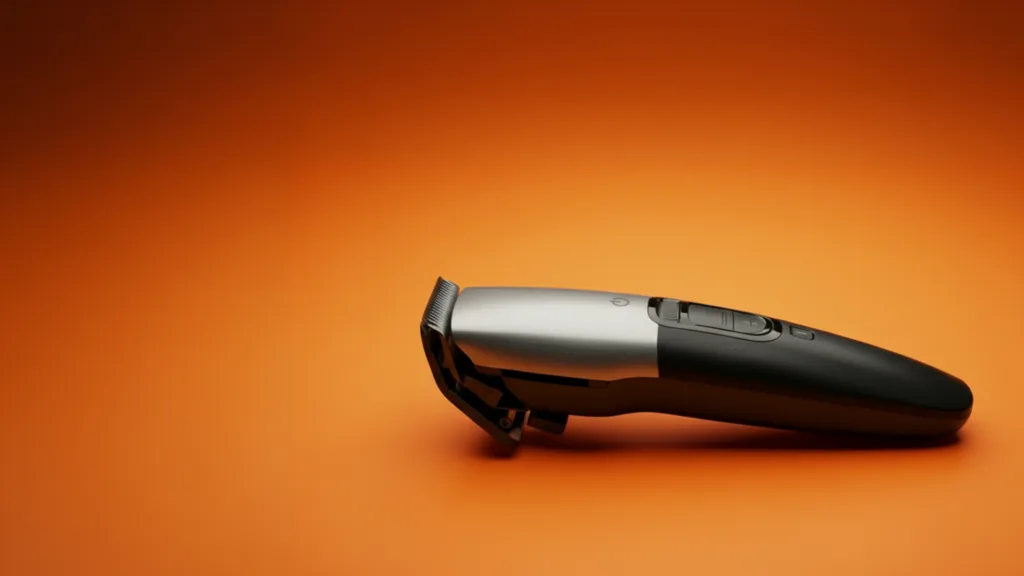
Can an oval dot pattern on the handle of a razor be a registered trademark? This is exactly what Philips tried to do with a position mark. However, the EUIPO has now finally rejected the application. The reasoning shows where the limits of trademark protection for product designs lie.
What is it about?
The Dutch technology group Philips, which is known for its razors among other things, wanted to protect a certain graphic element as a so-called position mark . A position mark is not about the product itself or its name, but about the exact position and design of a certain symbol on the device.
The sign in question consists of several oval shapes (so-called superellipses) of different sizes, which are applied in a contrasting color on the upper part of the razor handle. Philips applied to register this design throughout the EU as a trademark for razors, hair clippers, beard trimmers, epilators and similar products.
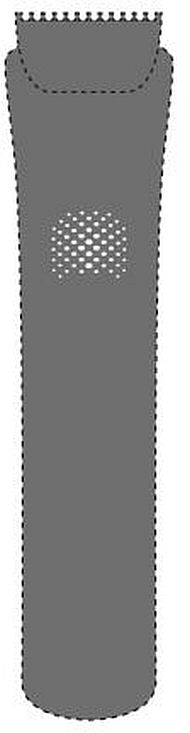
However, the European Intellectual Property Office (EUIPO) based in Alicante rejected the application in a decision dated February 25, 2026.
What Philips argued
Philips had essentially put forward the following arguments in the registration proceedings:
- The design is not an ordinary decorative element, but a clearly defined, independent graphic design that is comparable to a logo printed on the product. It is not necessary to check whether such signs clearly deviate from what is customary on the market.
- The arrangement of the oval shapes is unique in its entirety and has an unmistakable outline that is somewhat reminiscent of a thumbprint. This specific image is suitable for drawing customers’ attention to the origin of the product.
- In practice, the pattern is used as a flat, printed graphic element, not as a three-dimensional corrugation or raised grip structure, as is common with other manufacturers. This difference is relevant under trademark law.
- The EUIPO has already registered an almost identical sign as a trademark (under the number 1838573). This proves that the design is generally capable of being a trademark.
Why the EUIPO still said no
The EUIPO did not accept any of these arguments.
Consumers see decoration, not a trademark.
The EUIPO found that similar patterns are widely used on razors and hair clippers – mostly as a visual enhancement or to identify the handle area. When a customer picks up a razor, they don’t think: “Aha, this is a sign for manufacturer X.” They simply see a handle element or an ornament. This is not sufficient for trademark protection, because a trademark must directly indicate the manufacturer to the customer.
Average consumers generally do not draw any conclusions about the origin of products from decorative patterns on them.
Consumers do not analyze patterns.
Philips had explained in detail how special the geometric shape of the superellipse arrangement was – with a characteristic outline resembling an inverted “W” shape. The EUIPO replied that a consumer looking at a product in a store does not carry out such a detailed analysis. They take a quick look and buy – or not. It is not sufficient for trademark protection that a specialist would recognize a special feature on closer inspection.
Another registered trademark is not proof.
The reference to the already registered sister trademark (No. 1838573) did not work. That trademark is a purely figurative sign without a fixed position on a product. The EUIPO had no way of assessing how the sign was actually used. With a position mark, on the other hand, this is precisely what is known – and this is precisely why it is possible to assess how consumers perceive it. As this is a different situation, the earlier decision is not transferable.
Which scale applies to position markers?
In trademark law , it is controversial how strictly position marks must be examined. Philips referred to a ruling by the European Court of Justice (ECJ) from 2020, which concerned the Swedish public transport provider Östgötatrafiken. In this case, the ECJ ruled that systematically and spatially limited applied color patterns do not necessarily have to be examined according to the strictest standard, namely whether they deviate significantly from the industry standard.
The EUIPO deliberately left open whether this judgment is applicable here at all. Because the result is the same either way. Even if the more favorable standard is applied, the Philips design lacks distinctive character.
What companies can learn from this
The decision provides important information for all companies wishing to protect their product design as a trademark.
Looks alone are not enough. Even a sophisticated design element can fail as a trademark if customers perceive it as a typical product or decorative feature and not as a reference to the manufacturer.
Anyone who has made a lot of sales with a sign should be able to prove this. If a sign has become known on the market through long and intensive use, it can still obtain trademark protection, even if it was not originally distinctive. Philips has not taken this route here.
Older own trademarks are not a carte blanche. Just because a similar sign was registered earlier does not mean that a new application will automatically be successful. Each application is assessed separately.
Handle areas are tricky. Patterns that are applied exactly where a user touches a device are easily interpreted as a technical or decorative feature of the handle and are not recognized as a trademark.
Conclusion
Anyone wishing to protect a graphic element on an everyday appliance as a trademark must prove that consumers actually perceive it as an indication of origin and not just as a pretty decoration or useful functional feature. This requirement is high and, in case of doubt, requires tangible evidence from the market.
Companies should consider these aspects as early as the product design stage and subsequently in their IP strategy.
We are happy to
advise you about
Trademark law!