


Distribution
photos and
Trade.
Distribution
photos and
Trade.
The best possible protection starts with understanding: We know the legal challenges of trade in IP and IT law, both online and offline. and have been successfully advising our clients in this area for many years.
Retail sector
The retail sector is one of the main pillars of the German and European economy. It comprises retail, wholesale and the constantly growing online trade and connects manufacturers and consumers via a variety of distribution channels. The sector is characterized by intense competition, rising customer expectations and an increasing regulatory environment. The spectrum of business models ranges from traditional retail stores to wholesale distribution and e-commerce stores, each of which brings its own legal challenges.
The retail sector has changed fundamentally in recent years. Online retail has not displaced bricks-and-mortar retail, but it has changed it profoundly. Omnichannel strategies, in which stationary and digital sales are interlinked, are indispensable for many retail companies today. At the same time, international platforms such as Amazon, Temu and Shein are pushing into the European market and intensifying competition. The globalization of supply chains, the digitalization of business processes and new regulatory requirements for product safety, sustainability and consumer protection present retail companies with complex challenges that require legal advice that goes beyond purely national law.
Sustainability and consumer protection are also becoming increasingly important in the retail sector. Stricter labeling and information requirements, new regulations on environmental and sustainability claims as part of the EmpCo Directive and the EU warranty and guarantee label, which will be mandatory from 2026, demand a high degree of diligence and legal compliance from retail companies. Those who deal with these requirements at an early stage will gain a decisive competitive advantage.
Retail thrives on strong trademarks, fair competition and customer trust. Only those who protect their trademarks, comply with regulatory requirements and use the opportunities of digitalization in a legally compliant manner will be able to hold their own against the competition in the long term.
IP and IT law in the retail industry
The retail sector faces specific challenges in the area of intellectual property (IP) and information technology (IT) law. Trademarks are of central importance for retail companies, whether as own brands or trademarks, as company identifiers or as an instrument for differentiation in competition. At the same time, retailers are particularly affected by competition law requirements, especially in the areas of price information, product labeling and consumer protection. The increasing shift of business processes into the digital space also raises questions of IT law, e-commerce and data protection. Sound legal advice in IP and IT law is therefore essential for retail companies of all sizes in order to secure competitive advantages and minimize legal risks.
Depending on the business model and orientation of the company, different areas of law in the field of IP and IT law can become relevant.
Trademarks in retail
Trademarks are a central strategic instrument for retail companies. This applies not only to the protection of the company name and logo, but also in particular to the development and protection of own brands and private labels. For many retail companies, own brands that are offered exclusively through their own distribution network are a decisive competitive differentiator and an effective means of building customer loyalty. The protection of these own brands under trademark law requires a careful trademark strategy, which takes particular account of the distinction between goods marks and trade service marks in Class 35. According to the case law of the Federal Patent Court, a precise distinction must be made at the time of application as to whether the trademark is intended to protect the sale of the company’s own goods or the compilation of a range of third-party products.
Retail companies are also particularly affected by trademark infringements by third parties. In particular, the sale of counterfeit branded products via online platforms poses a considerable risk. According to the EU Intellectual Property Agency (EUIPO), trademark and product piracy causes considerable economic damage to European manufacturers every year. It is therefore crucial for retail companies that sell branded goods to ensure the authenticity of the products they sell and to take consistent action against brand counterfeiting.
We support retail companies worldwide in the registration, administration and monitoring of trademarks, including private labels and trade service marks, and carry out similarity searches in advance to avoid conflicts with existing laws. On behalf of our clients, we effectively enforce trademark rights against infringers or defend against trademark claims. In the fight against product piracy, we work together with the customs authorities to intercept illegal counterfeits directly at the border and prevent them from entering the market in the first place.
Designs and copyrights in trade
Design law protects the external design of products. In the retail sector, these are primarily product packaging, label designs and the design of private label packaging, which contribute significantly to recognition and differentiation at the point of sale. With a registered design right, imitations of packaging designs can be prevented or effectively combated. If the designs are particularly creative, they can also be protected by copyright. The main advantage over design law is the longer term of protection.
For retail companies that sell products from other manufacturers,copyright issues also arise in connection with the use of product photos, descriptive texts and marketing materials from manufacturers. Without the corresponding rights of use, manufacturers’ images may not be used for their own online stores or advertising appearances. It is therefore advisable for every retailer to clearly regulate the rights of use with the suppliers.
We support commercial enterprises worldwide in the registration, administration and monitoring of designs and registered designs and, if required, also carry out prior research into novelty and individual character. We effectively enforce copyrights and design rights against infringers or defend against corresponding claims.
Competition law and labeling obligations
Hardly any other industry is affected as much by competition law regulations and labeling obligations as the retail sector. Competition law offers protection against unfair practices by competitors on the one hand and protects consumers through extensive information and labeling obligations on the other.
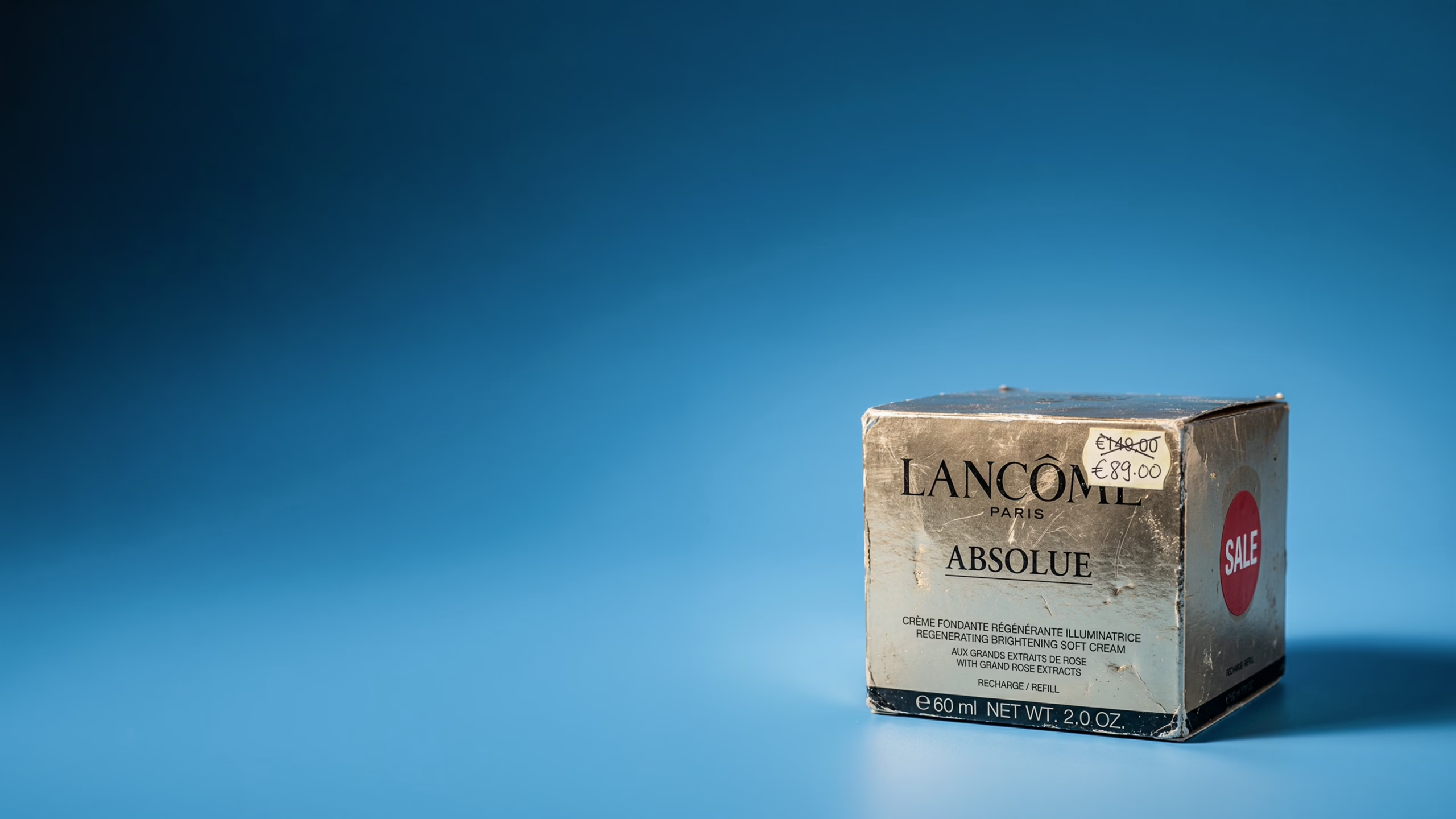
The Price Indication Regulation (PAngV) is of particular practical importance for retailers. Since the amendment in May 2022, stricter requirements have applied to price advertising. Retail companies that advertise price reductions must state the lowest total price of the last 30 days before the price reduction.
In addition, retail companies must comply with a large number of other information obligations that vary depending on the sales channel and product category. These include basic price information in accordance with the Price Indication Regulation (PAngV), product safety requirements in accordance with the European Product Safety Regulation (GPSR), industry-specific labeling obligations, for example in the area of textile labeling or food labeling and, since 2025, the obligations arising from the EU AI Regulation when using AI-supported systems in customer contact. From September 27, 2026, the new EU-wide warranty and guarantee labels will also come into force, which retailers in stationary and online retail must implement. Finally, with the EmpCo Directive, environmental and sustainability claims such as “environmentally friendly” or “climate neutral” will only be permitted in future if they are clearly verifiable and meet clear criteria.
We support retail companies in the enforcement of and defense against competition law claims and advise on compliance with the various labeling and information obligations in order to avoid cease and desist letters and fines.
IT law, e-commerce and data protection
Digitalization has fundamentally changed the retail sector. The share of e-commerce in overall trade is growing steadily, and brick-and-mortar retailers are also increasingly using digital sales channels. Selling via their own online stores, via platforms such as Amazon, eBay or Zalando and via social media channels brings with it a multitude of legal issues.
In addition to the general commercial regulations, numerous special regulations apply to online trading, in particular to distance selling law, the right of withdrawal and pre-contractual information obligations. From June 19, 2026, the mandatory withdrawal button will be introduced, which is intended to offer consumers the same ease of withdrawal as they have when concluding a contract. Retail companies that sell via online marketplaces must also observe the platform-specific requirements, for example with regard to liability for trademark infringements by third-party providers or the requirements for product information.
The use of artificial intelligence in retail, for example for personalized product recommendations, chatbots or dynamic pricing, also requires compliance with the EU AI Act, which stipulates transparency, documentation and labelling obligations depending on the area of application. IT security requirements are also increasing, particularly as a result of the NIS 2 Directive, which may affect medium-sized and larger retail companies with digital infrastructures.
Data protection issues also play a central role in retail. The processing of customer data, the use of tracking tools and personalized advertising as well as the data protection-compliant design of online stores and apps require careful implementation of the provisions of the General Data Protection Regulation (GDPR).
We support retail companies with digitalization projects, the legally compliant design of online stores and platform presences and the implementation of data protection regulations.
Our expertise – your advantage
Our many years of experience and specialization in IP and IT law enable us to develop tailor-made solutions for the specific requirements of the retail industry. We support you from strategic advice through to the enforcement of your laws to ensure your long-term success in this dynamic market environment.
Our team
for the trade
Our team
for the trade