


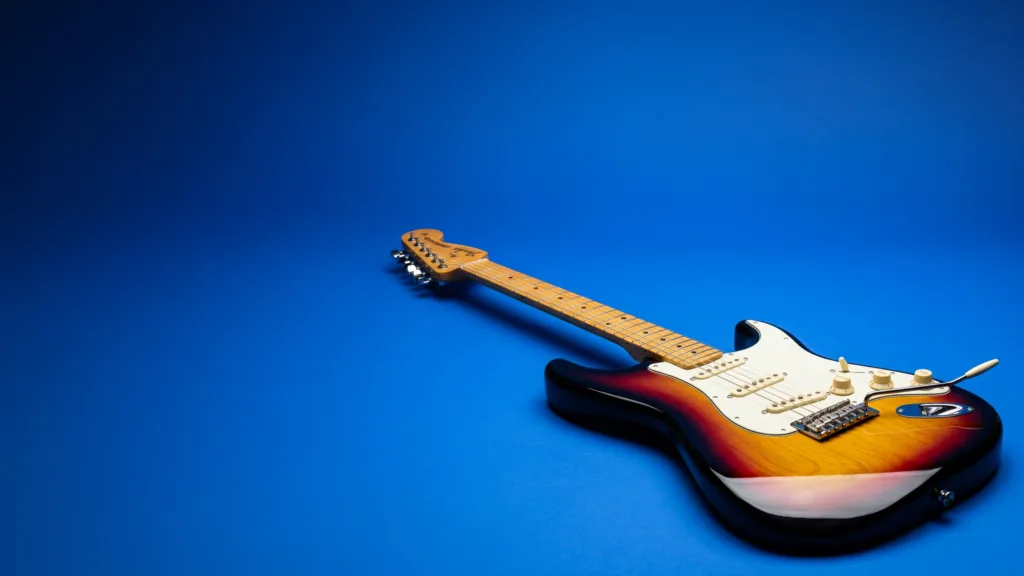
Copyright
for
Stratocaster.
Copyright
for
Stratocaster.
of
Can a 70-year-old guitar shape still enjoy copyright protection today? Is an almost identical copy sufficient to constitute copyright infringement if the trademark logo is missing?
The Stratocaster and its creator
Leo Fender designed the Stratocaster in 1954 and its distinctive shape has remained virtually unchanged to this day. Fender himself died in 1991, and the laws to his creation have been owned by the current Fender Musical Instruments Corporation since 1985. It acquired them from Leo Fender’s original company over several stages.
Copies on AliExpress
A Chinese company sold electric guitars on the AliExpress platform under the name “SHUFFLE Musical Instruments Store” that looked confusingly similar to the Stratocaster. The price: 61.69 euros. In spring 2025, Fender had such a guitar bought on a trial basis. It was delivered to Meerbusch on May 27, 2025. This proved it: The product was actually being sold to Germany. The Chinese dealer let the deadline set by the court pass unused and did not get in touch. A default judgment was therefore issued by the Düsseldorf Regional Court on 22.12.2025 – Ref. 14c O 64/25 .
Does German law even apply to an American guitar?
Can a US company claim copyright protection in Germany for a product that was created in the USA in 1954? Yes, on the basis of an agreement between the German Reich and the United States of America from 1892. This agreement is still in force today and guarantees US citizens in Germany the same copyright protection as German authors. The court found that protection is measured exclusively according to German law. As Leo Fender died in 1991 and the German term of protection runs for 50 years after the death of the author, the Stratocaster is protected in Germany until at least 2041.
Can a guitar shape be protected at all?
Copyright normally protects art, music and literature. But everyday objects can also be protected if their form represents a genuine creative achievement. This is called applied art. So the court had to examine whether the Stratocaster body is more than just a functional guitar shape?
The Düsseldorf Regional Court affirms this with detailed reasons: The soft curves are reminiscent of a female torso consisting of hips, waist and arms. The two sides are deliberately uneven. The left horn is more elongated than the law and gives the impression of reaching for something. The slight flattening on the front reinforces the image of a turning movement. All of this was completely new in 1954 and bears the unmistakable signature of its creator.
The court also followed a ruling by the European Court of Justice, which clarified that even a pronounced aesthetic effect alone does not constitute copyright. The decisive factor is that the personality of the creator is visible in the form, which the court affirmed in the case of the Stratocaster body.
The body of the Stratocaster created by Leo Fender is an outstanding, free creative achievement that clearly reflects the personality of its author and thus constitutes a copyright work.
Why is it not enough to leave out the logo?
Obviously, the Chinese dealer had not printed the Fender logo on the copy and had chosen a different color. However, this did not change anything. This is because copyright protects the artistic form, not the trademark. The only relevant factor is whether the characteristic design features of the original were adopted in a recognizable way. And that was the case here with the same body shape, the same pickguard, the same position of the cable outlet, the same dimensions and the same flattening on the back.
In doing so, the court implemented a new standard of review developed by the European Court of Justice. The question is no longer whether two products have the same overall effect, but whether the creative elements of the original are recognizable in the replica. This provides better protection for authors, as the adoption of individual distinctive features can be sufficient.
Conclusion
The fact that everyday objects can be protected by copyright is nothing new. However, the standard for assessing whether an object enjoys copyright protection and how far this extends has recently shifted in favor of authors. Authors can therefore take more successful action against imitations and replicas.
For retailers, this means being careful with products that are based on well-known or specially designed products and checking the legal situation before offering such products. Otherwise, there is a risk of cease and desist letters and claims for damages.
We are happy to
advise you about
Copyright!