

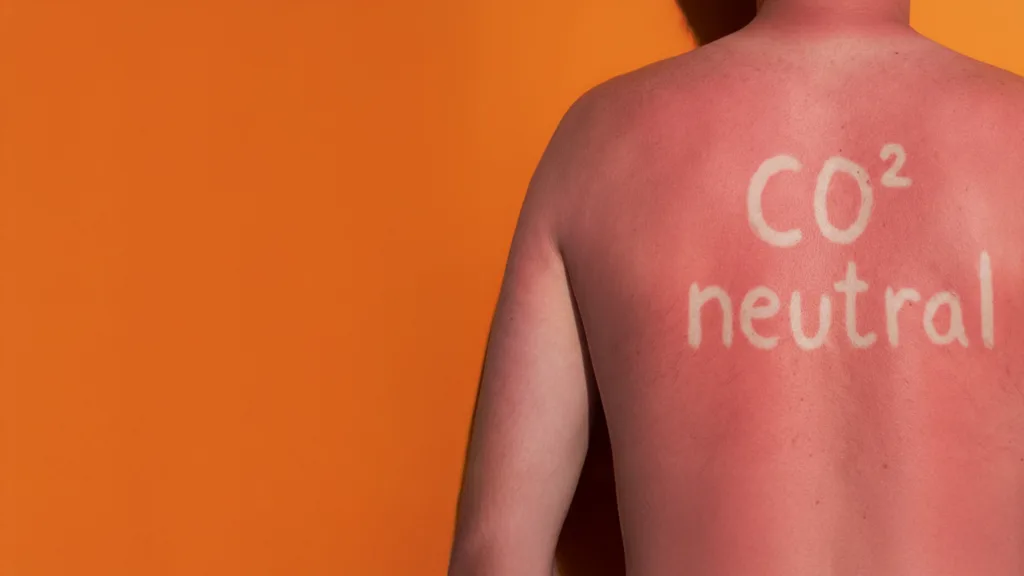
Climate neutral
Advertising
unfair.
Climate neutral
Advertising
unfair.
from
Can a cosmetics company advertise sun protection as “climate neutral” – if nothing is explained? And how “natural” is “natural care” if it contains synthetic ingredients?
Climate-neutral interior cream?
A cosmetics company offered a sunscreen product. The packaging featured a round symbol with the words “climate” and “neutral”. The sun cream was also advertised with statements such as “Reliable sun protection combined with natural cosmetics” and “Natural care without compromise”.
The Federation of German Consumer Organizations (vzbv ) considered the advertising to be unfair and took legal action against it. In the view of the consumer advocates, the “climate-neutral” advertising was misleading. The term “climate-neutral” could be understood both in the sense of a CO₂ reduction during production and in the sense of mere CO₂ compensation, without the advertising making this clear. In addition, the advertising with “natural” is misleading if the proportion of natural ingredients is actually only 51.9%.
Climate-neutral and natural
Environmental and sustainability claims (“climate neutral”, “environmentally friendly”) have a strong sales-promoting effect. This is precisely why competition law requires such claims to be correct, clear and understandable for consumers. If important information is missing, even the omission (not just a false claim) can be problematic. This applies in particular to labels/seals, whose claims are easily overestimated by consumers without context.
Similarly with “natural”: in the cosmetics sector, many shoppers associate “natural care” not only with a “little bit of nature”, but often with the expectation that a product consists (almost) entirely of natural ingredients – or at least is not composed of “classic synthetic” ingredients. How far this expectation extends depends heavily on the wording (“natural” vs. “with natural ingredients”), the product context and the specific presentation.
Marburg Regional Court prohibits advertising
With Judgment of 29.10.2025 – Ref. 1 O 243/24 the Marburg Regional Court prohibited the cosmetics company from continuing to use the objectionable statements in their previous form.
The focus was initially on the “climate-neutral” symbol used. According to the court, such a label gives the impression that no or practically no carbon dioxide emissions are produced during production and distribution. However, CO2 was actually produced. Whether these emissions were offset remained open to consumers. This was precisely where the court saw the problem: without a clear explanation of whether climate neutrality was achieved through avoidance, reduction or mere compensation, the statement was too vague and therefore misleading.
This statement does not correspond to the facts, because CO2 is produced during the manufacture of the products
The naturalness advertising did not stand up to judicial scrutiny either. In the court’s opinion, the statement “Reliable sun protection combined with natural cosmetics” suggested more than just individual natural ingredients. Consumers expect a product whose composition is essentially characterized by natural ingredients. With a natural origin of only 51.9 percent and the use of synthetic ingredients, this expectation was not fulfilled.
This is even clearer with the phrase “natural care without compromise”. This leaves hardly any room for relativization and gives the impression of a completely natural formula. For a product with synthetic ingredients, this is simply too much of a promise.
Legal classification
The decision fits seamlessly into a series of rulings with which courts have curbed greenwashing and exaggerated sustainability promises in recent years. It is not so much the result that is new, but rather the clarity with which the Marburg Regional Court emphasizes that unclear labels and euphonious slogans are to the detriment of the advertising company.
This becomes particularly clear with the “climate neutral” symbol. Precisely because it looks like an official seal, the court expects a high degree of transparency. Such a label must not promise more than it declares. If there is no explanation, all that remains is the advertising effect – and that is not enough in legal terms.
Outlook: EmpCo directive further tightens the standard
The ruling by Marburg Regional Court is also a foretaste of what companies will have to face with the implementation of the EmpCo Directive (Empowering Consumers for the Green Transition). The directive aims to better protect consumers from misleading environmental advertising and to curb blanket sustainability promises.
In future, general environmental claims such as “climate-neutral”, “environmentally friendly” or “sustainable” will only be permitted if they are based on recognized, verifiable and transparent criteria. Pure compensation models are particularly subject to criticism. Self-designed labels without independent verification are also to be treated much more strictly or banned altogether.
If these requirements are applied to the case from Marburg, it becomes clear that the advertising complained of would hardly have been sustainable even under future legislation. The trend is clearly moving towards complete transparency and away from green-colored short messages.
Conclusion
The ruling is in line with other rulings on environmental claims such as “climate neutral” and once again makes it clear that advertising with sustainability is only permitted if there is evidence of sustainability and not mere greenwashing.
In view of the forthcoming implementation of the EmpCo Directive, this standard is becoming even stricter. After that, corresponding seals would only be permitted with a corresponding certification system.
Companies are therefore well advised to critically review their environmental statements now in order to avoid future cease and desist letters.
We are happy to
advise you about
Competition law!